
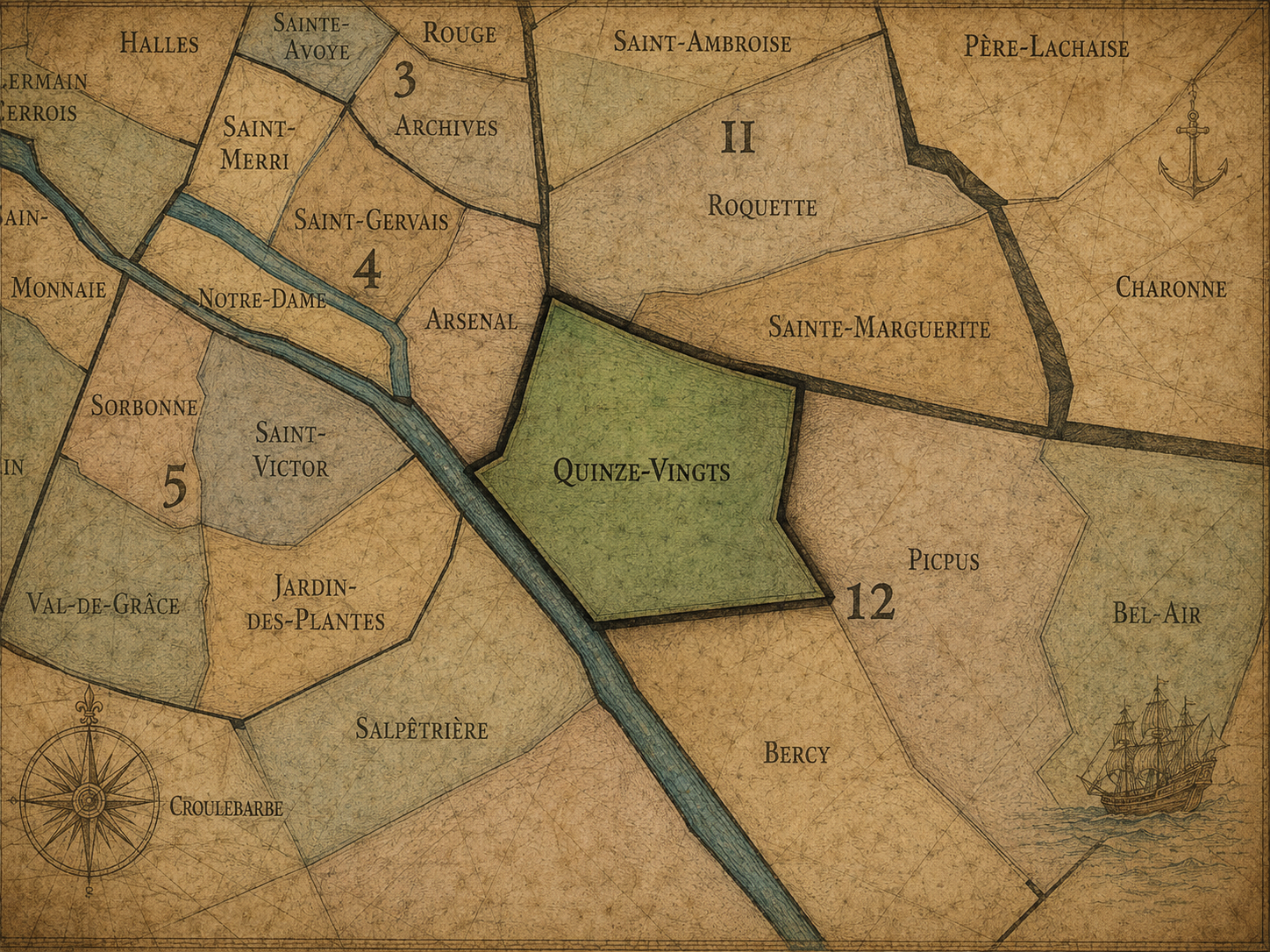
12e - QUINZE-VINGTS
Quartiers Administratifs
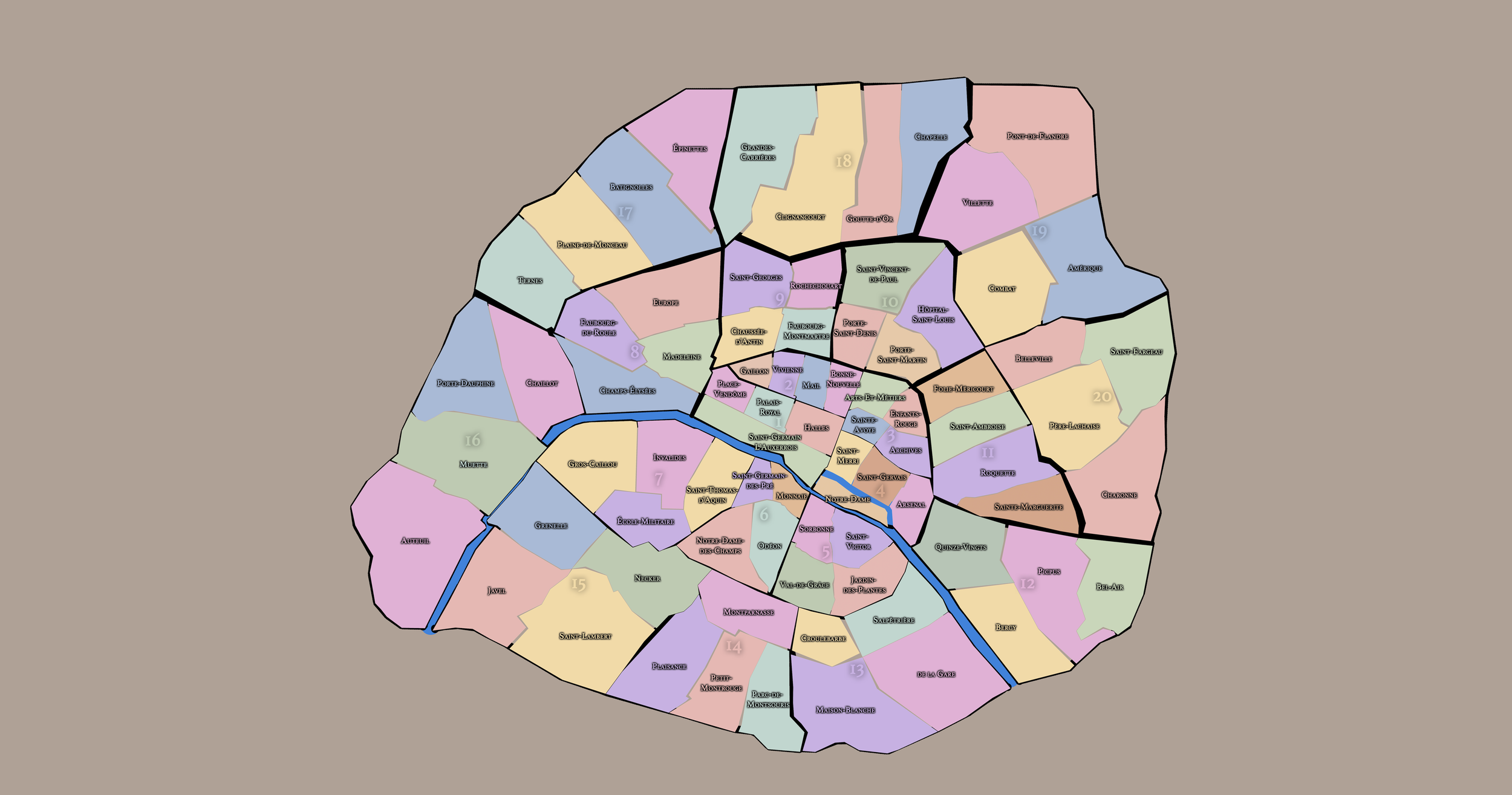
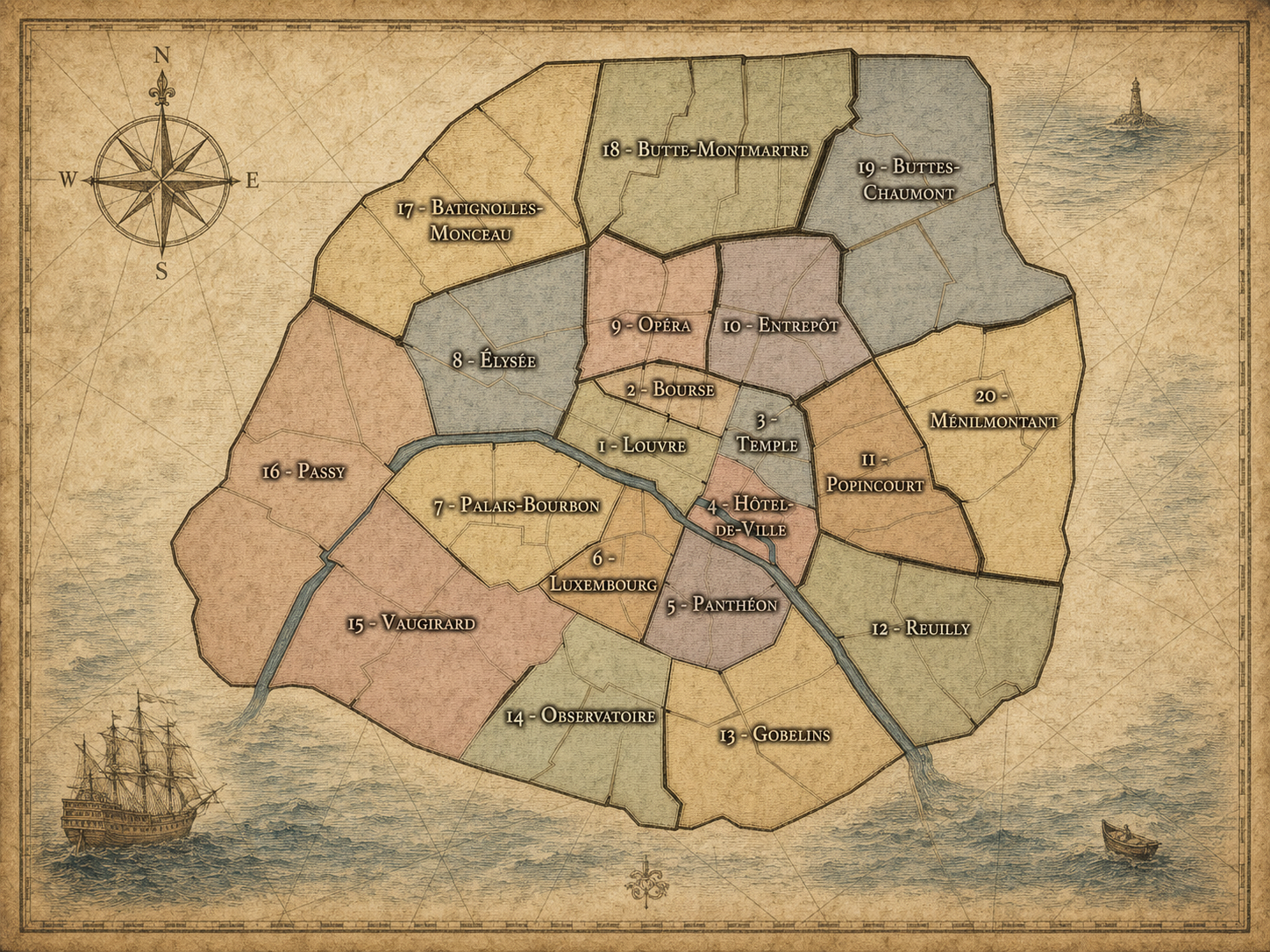
Part of an ongoing project to walk and photograph every neighborhood in Paris, this page explores the Administrative Quarter: 12e - Quinze-Vingts through maps, district identity, history, and photography.
The Map
Download the Paris Arrondissements Map
Geographic Setting
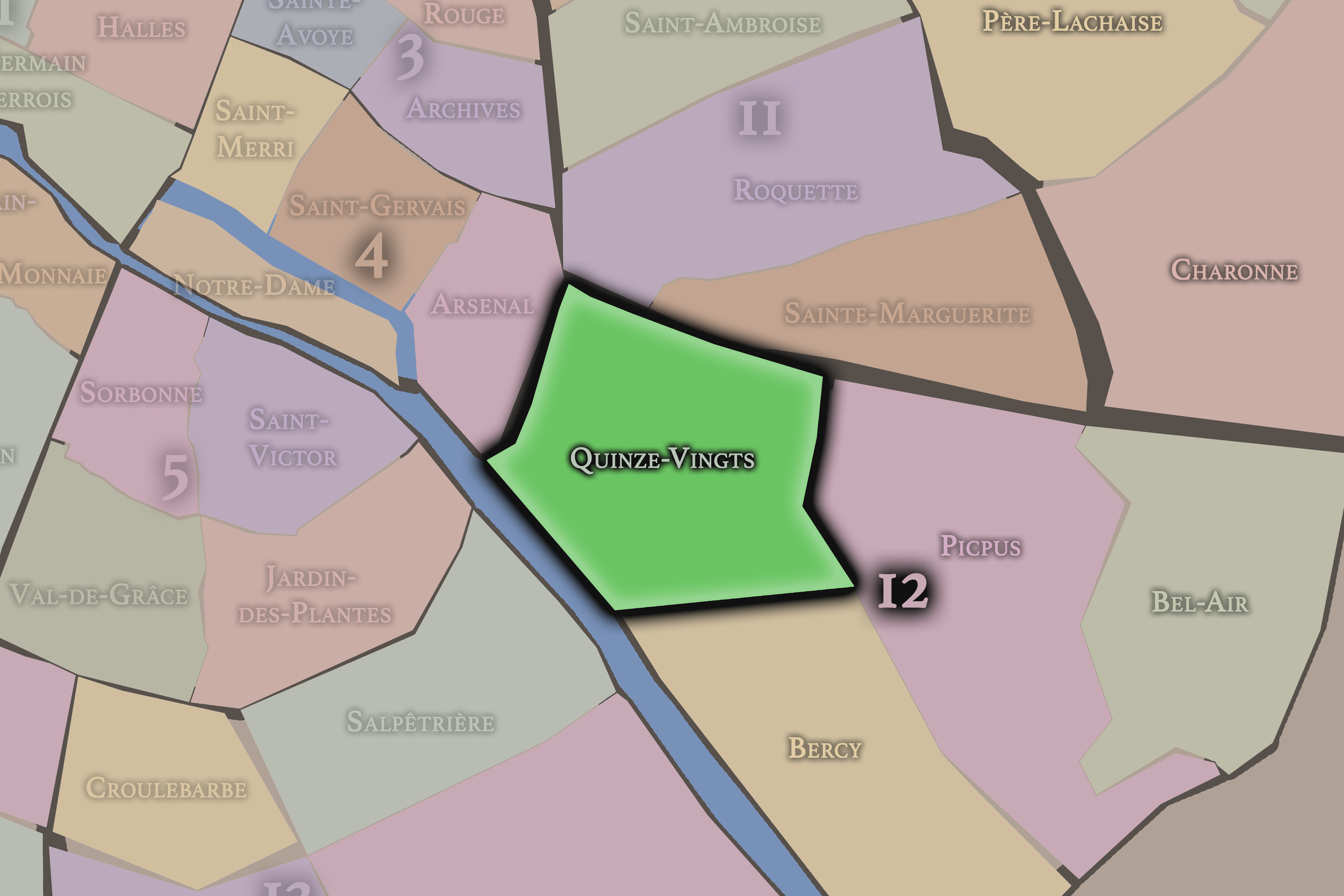
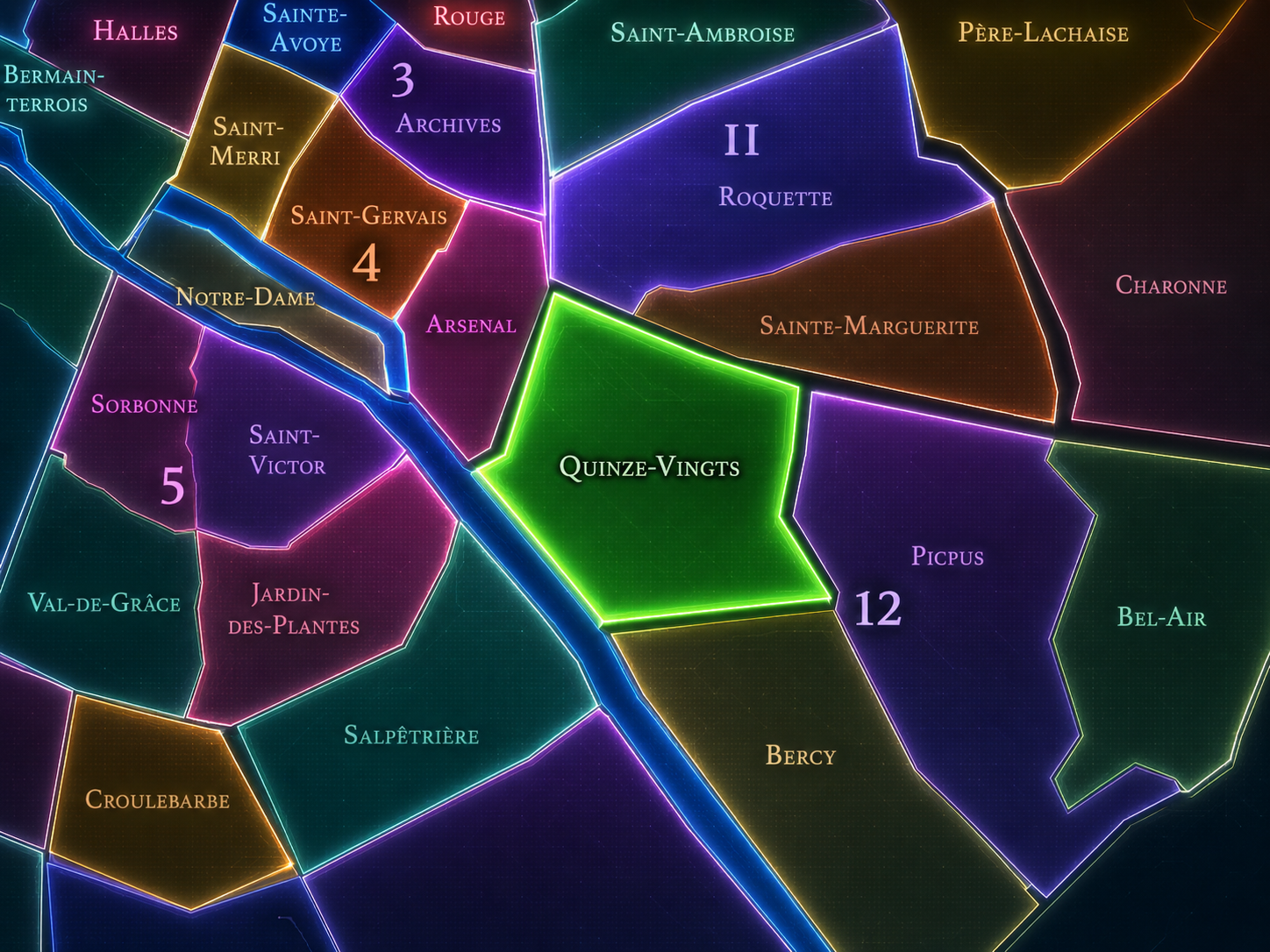
Quinze-Vingts occupies the western portion of the 12th arrondissement, where Bastille opens eastward into the modern, rail-driven, craft-lined, and residential landscapes of the arrondissement. It sits between Arsenal in the 4th arrondissement to the west, Picpus and Bercy farther east and southeast, and Sainte-Marguerite in the 11th arrondissement to the north. This is the 12th arrondissement at its most connective: a quarter of thresholds between Bastille, Gare de Lyon, Rue de Charenton, Avenue Daumesnil, the Viaduc des Arts, the Coulée verte René-Dumont, and the older working corridors of the Faubourg Saint-Antoine.
Its geography is shaped by the western entrance into the 12th. The Place de la Bastille, Opéra Bastille, Rue de Lyon, Rue de Charenton, Rue du Faubourg-Saint-Antoine, Avenue Daumesnil, the Gare de Lyon approaches, and the elevated arches of the Viaduc des Arts all give the quarter a powerful sense of movement and reuse. The Hôpital national des Quinze-Vingts stands at 28 Rue de Charenton, giving the quarter its official name and one of its deepest historical anchors. The hospital itself traces its institutional history back to a foundation by Louis IX around 1260, though its present location in the 12th belongs to a later transfer.
Unlike Bercy, whose identity is riverfront, warehouse-based, and redeveloped at large scale, or Bel-Air, whose character opens toward the Bois de Vincennes and the city’s eastern edge, Quinze-Vingts is a quarter of passage and conversion. It is the 12th as entry: Bastille into the arrondissement, old rail into garden, viaduct into artisan corridor, hospital foundation into modern ophthalmology center, and faubourg street into contemporary neighborhood life.
Administrative Quarter Identity
Etymology and Origins
The name Quinze-Vingts comes from the Hôpital des Quinze-Vingts. In medieval French counting, “quinze-vingts” means fifteen twenties, or 300. The hospital’s own history explains that the name came from the old vigesimal way of counting by twenties and referred to the institution’s intended community of fifteen times twenty members. Founded by King Louis IX, known as Saint Louis, around 1260, the original “maison des pauvres aveugles de Paris” was created to house blind people.
This makes the quarter’s name unusually numerical and unusually humane. It does not begin with a church, gate, village, market, or aristocratic estate. It begins with a number of people — a community of blind residents for whom the institution was created. The name carries medieval charity, royal piety, disability history, and the city’s long relationship to care.
That origin gives Quinze-Vingts a special place among the administrative quarters of Paris. It is a neighborhood whose name preserves not only a place, but an act of provision. The quarter’s identity begins with the visibility of those whom the city and monarchy chose to house, protect, and organize. Even today, as the hospital functions as a national ophthalmology center, the name keeps the older memory of blindness and care alive inside the modern city.
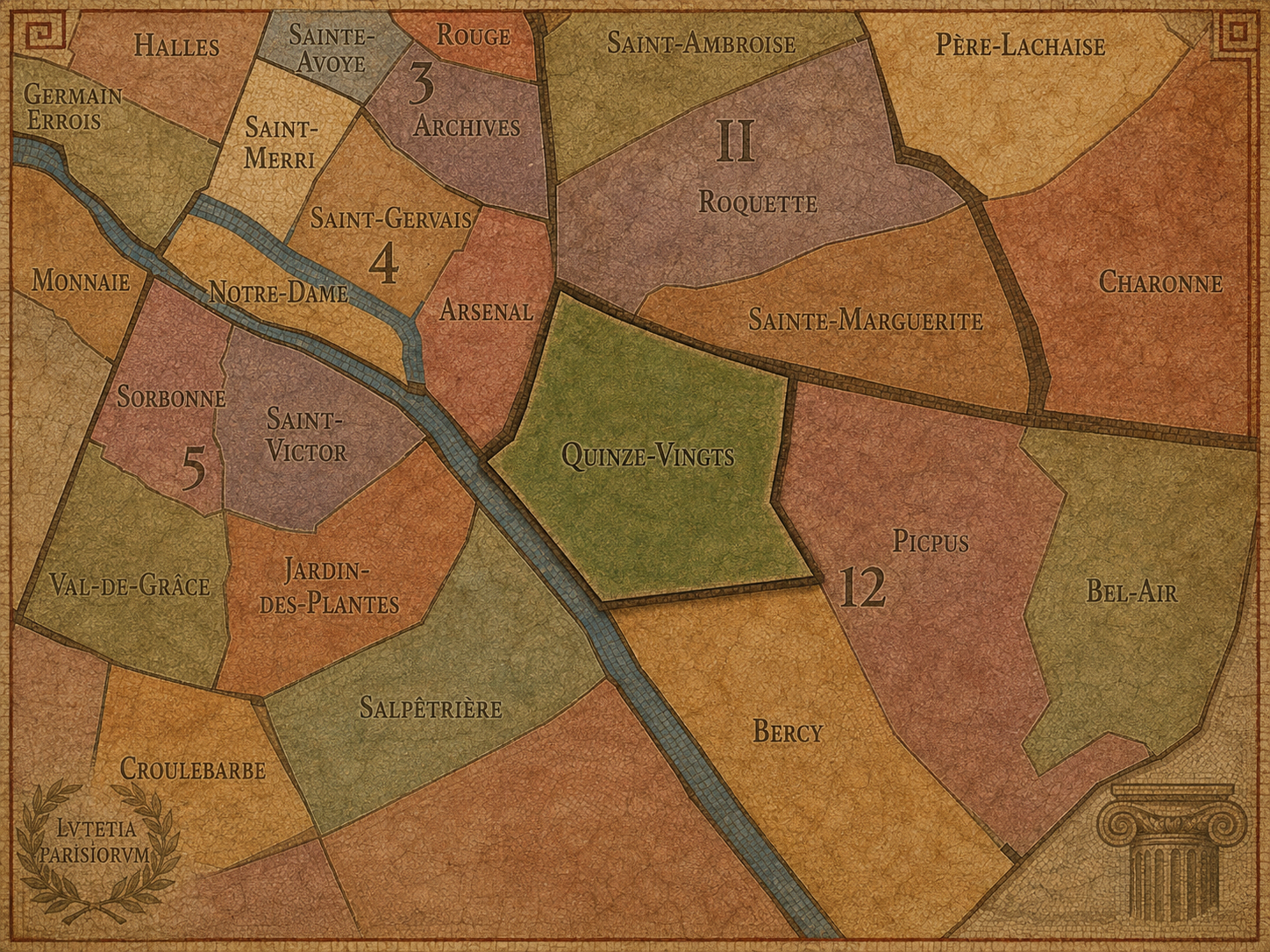
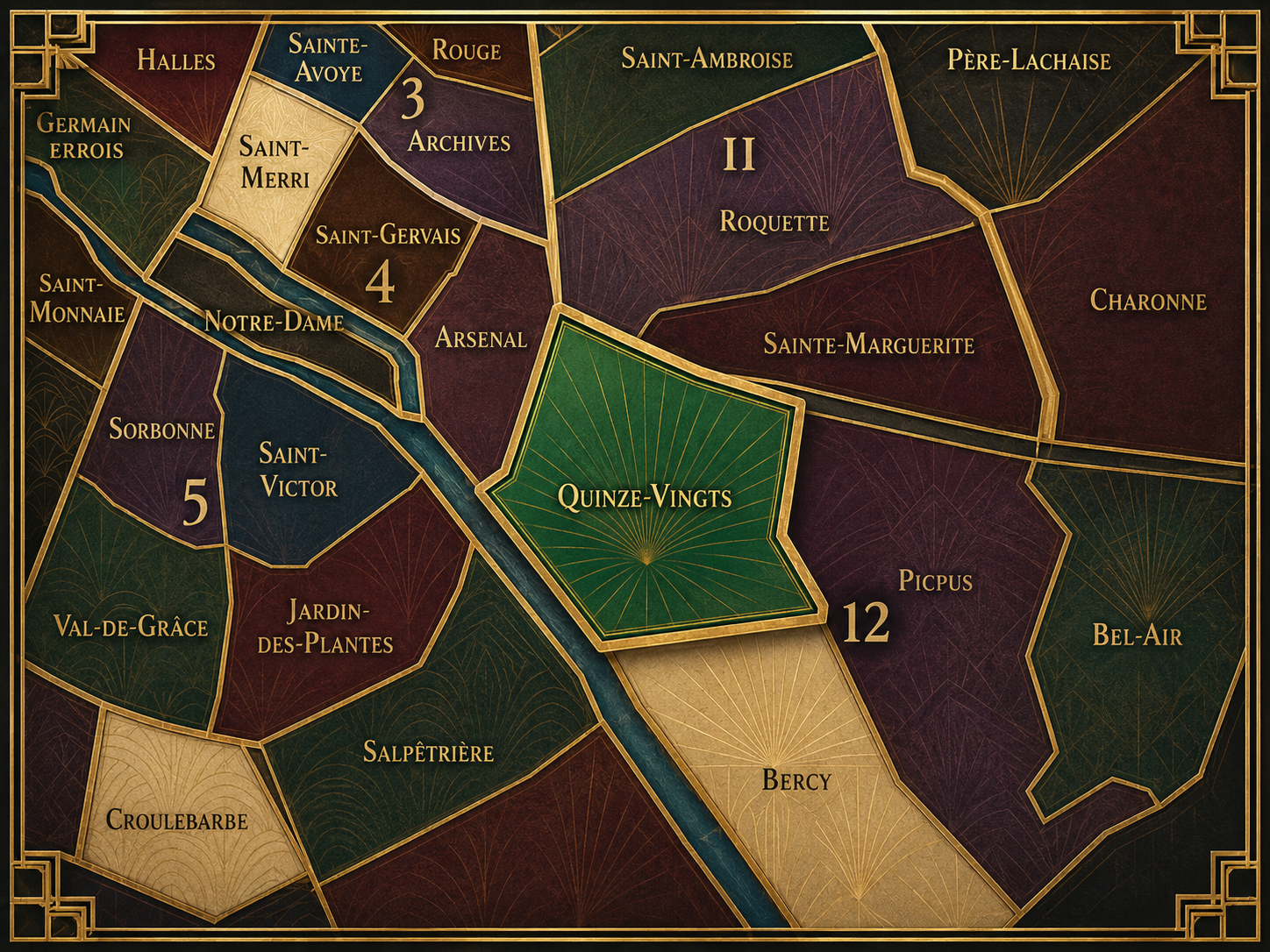
Within the official geography of Paris, Quinze-Vingts is one of the four administrative quarters of the 12th arrondissement, alongside Picpus, Bercy, and Bel-Air. It occupies the arrondissement’s western sector and is traditionally counted as the 48th administrative quarter of Paris. District references identify it as the westernmost quarter of the 12th and note that it takes its name from the hospital on Rue de Charenton.
As an administrative quarter, Quinze-Vingts clarifies a landscape that is often described through stronger everyday names: Bastille, Gare de Lyon, Daumesnil, Rue de Charenton, Viaduc des Arts, or Faubourg Saint-Antoine. The official name gathers these overlapping identities into one civic unit. It reminds us that the western 12th is not only Bastille-adjacent or station-adjacent, but also anchored by one of Paris’s oldest institutions of care.
This civic frame is especially useful because the quarter sits at a seam between several urban systems. Bastille gives it revolutionary and cultural proximity. Gare de Lyon gives it rail movement. Rue de Charenton and Faubourg Saint-Antoine give it working and craft memory. The Viaduc des Arts and Coulée verte give it contemporary adaptive reuse. The hospital gives it moral and medical continuity. Quinze-Vingts is where these layers enter the 12th together.
Civic Framework
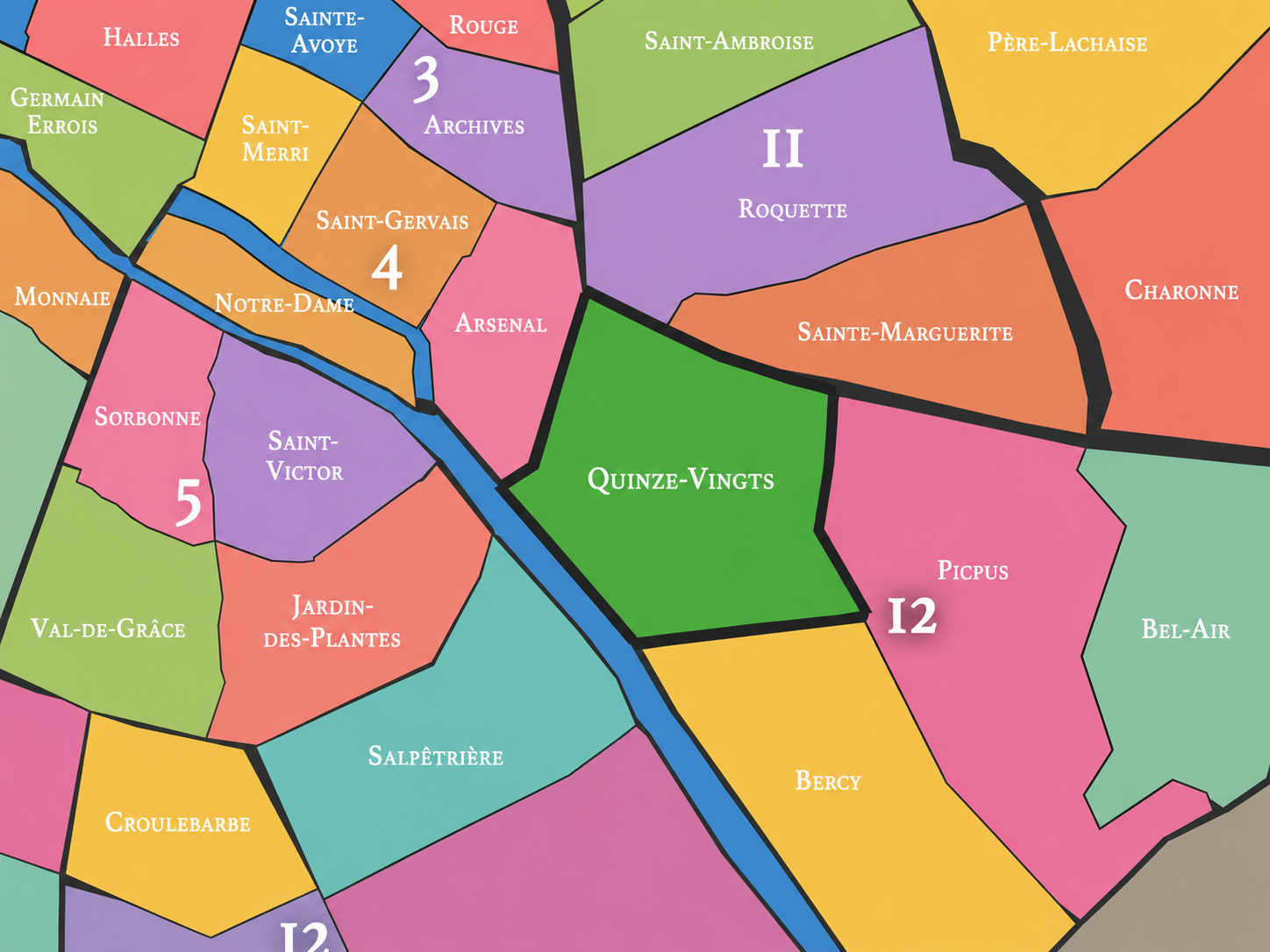
Quinze-Vingts differs from the other quarters of the 12th arrondissement through its western threshold position and its combination of hospital, station, craft, rail, and Bastille-adjacent identities. Picpus is quieter, more interior, and more memorial, shaped by religious history, the Revolution, the Cimetière de Picpus, and residential streets around Nation and Daumesnil. Bercy is defined by the Seine, wine warehouses, rail yards, parkland, arena, finance ministry, and large-scale redevelopment. Bel-Air is more residential and edge-oriented, opening toward the Bois de Vincennes and the city’s eastern boundary.
Quinze-Vingts is more immediate and connective. It is the quarter one enters when moving from Bastille into the 12th. It holds the hospital on Rue de Charenton, the Opéra Bastille edge, the Gare de Lyon landscape, the artisan arches of Avenue Daumesnil, and the beginning of one of Paris’s most important green reuse corridors. Its identity is not singular. It is a hinge.
It should also be distinguished from Bastille itself. Bastille is a symbolic square and a larger cultural district crossing arrondissement boundaries. Quinze-Vingts is the 12th arrondissement’s official quarter on the eastern side of that threshold. It receives Bastille’s force, but it converts it into something more specifically 12th: rail, hospital, craft, avenue, viaduct, and neighborhood.
Neighborhood Distinction
Parisian Identity
Quinze-Vingts expresses Paris as a city of care and transformation. Few quarters combine those themes so clearly. The hospital name carries the medieval memory of blind residents and royal charity; the modern institution carries ophthalmology and medical specialization; the Viaduc des Arts carries the conversion of railway infrastructure into artisan workshops; the Coulée verte carries the conversion of rail corridor into elevated garden. This is a quarter where use changes, but memory remains visible.
The Viaduc des Arts is especially important to the quarter’s contemporary identity. The 12th arrondissement’s mairie describes it as an ensemble of 62 arches, with nearly 50 dedicated to arts and crafts; it also notes that a railway line crossed the current 12th arrondissement in 1853 with its terminus at Place de la Bastille, and that after rehabilitation, the former rail line became the Coulée verte René-Dumont in 1994, with artisans occupying the arches below.
This gives Quinze-Vingts a distinctly Parisian kind of beauty: not only preservation, but adaptation. A medieval care institution becomes a modern medical center. A rail viaduct becomes an artisan corridor. An old line of movement becomes a planted promenade. The quarter’s identity rests in the city’s ability to reuse its inherited structures without flattening their past.
Neighborhood Connections
Every administrative quarter belongs to a wider Parisian fabric. These connections place Quinze-Vingts within the city’s civic, participatory, and cultural geography:
-
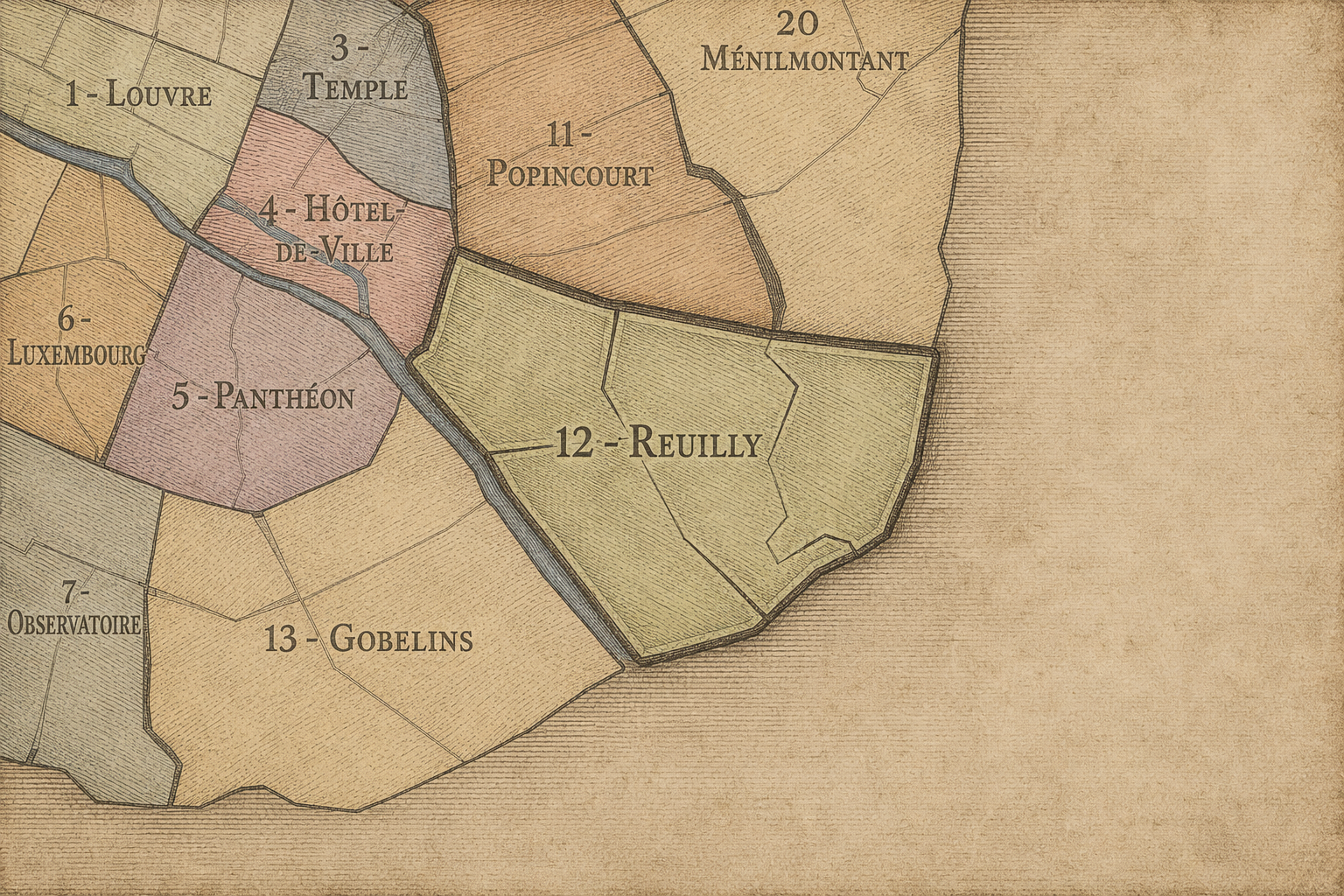
12e - Reuilly
-
Aligre-Gare de Lyon • Bercy • Jardin de Reuilly
The History
The origins of Quinze-Vingts are unusual because the institution that gives the quarter its name did not begin in the 12th arrondissement. The original Quinze-Vingts foundation was established by Louis IX around 1260 near the current Palais-Royal and Tuileries area, in what is now central Paris. Its purpose was not originally a hospital in the modern medical sense, but a living community for blind people, where residents could live with families and practice trades.
The present quarter’s origin, then, is partly a story of relocation. The name and institution traveled from the royal-central city to the eastern side of Paris. In 1779, under Louis XVI, Cardinal de Rohan transferred the hospital to Rue de Charenton, into the former barracks of the Black Musketeers.
This makes Quinze-Vingts different from many quarters whose names emerged from their local ground. Here, the name is both local and transplanted. The hospital brought its medieval identity into a new eastern landscape, and that transfer helped shape the modern quarter. The result is a neighborhood whose origins connect the 12th arrondissement to the medieval core of Paris, royal charity, military architecture, and the later expansion of the city eastward.
Origins
16th–17th Century
In the 16th and 17th centuries, the future Quinze-Vingts quarter belonged to the eastern outskirts of Paris, near the roads, faubourgs, and working landscapes extending beyond Bastille and the Faubourg Saint-Antoine. The area was not yet defined by the hospital, which remained in its older central location. Instead, this part of the future 12th developed through street routes, workshops, gardens, religious properties, military lands, and the expansion of the eastern city.
The surrounding Faubourg Saint-Antoine became increasingly important as a working and craft district. Furniture trades, workshops, and artisan life gave the eastern approach from Bastille a practical and productive identity. This wider world would later connect strongly to Quinze-Vingts through Rue de Charenton, Avenue Daumesnil, and the craft-oriented afterlife of the Viaduc des Arts.
The former barracks that later housed the relocated hospital also belong to the broader story of royal and military land use in eastern Paris. Before Quinze-Vingts became a hospital quarter, it was already a landscape where the city’s outer institutions — military, craft, road, and faubourg — gathered near the edge of the old capital.
The 18th century was decisive for Quinze-Vingts because it brought the hospital to the quarter’s present geography. In 1779, the decision was made to transfer the institution from its old location near the Louvre / Palais-Royal / Tuileries landscape to Rue de Charenton, using the former barracks of the Black Musketeers. That move placed a medieval charitable foundation inside the eastern faubourg world of the future 12th arrondissement.
This relocation transformed the meaning of the area. A site once associated with royal military use became a place of care for blind people. The change from barracks to hospital is one of the quarter’s most important early modern conversions: the architecture of discipline repurposed for shelter, treatment, and institutional community.
The French Revolution then altered the meaning of hospitals, charities, religious institutions, and royal foundations across Paris. Quinze-Vingts survived these upheavals as part of the city’s evolving public-care landscape. The institution’s royal-medieval origin did not disappear, but it was folded into a new civic order.
18th Century
19th Century
The 19th century transformed Quinze-Vingts through rail, street expansion, hospital specialization, and the modern growth of the 12th arrondissement. The hospital continued to anchor the quarter on Rue de Charenton, while the surrounding area became increasingly tied to Bastille, Gare de Lyon, Avenue Daumesnil, and the working east of Paris. The 1860 expansion of Paris brought this landscape fully within the modern arrondissement system.
Rail infrastructure became one of the defining forces of the quarter. In 1853, a railway line crossed the current 12th arrondissement with its terminus at Place de la Bastille, a line whose later viaduct would become one of the most important reuse landscapes in Paris. This created the structural basis for the later Viaduc des Arts and Coulée verte, but in the 19th century it belonged to the city of trains, freight, passengers, and industrial modernity.
The quarter also stood near the powerful world of Gare de Lyon, which made the western 12th a landscape of arrival and departure. Quinze-Vingts became a place where care, craft, road, rail, and eastern working Paris all met. Its 19th-century identity was not quiet; it was practical, mobile, and increasingly metropolitan.
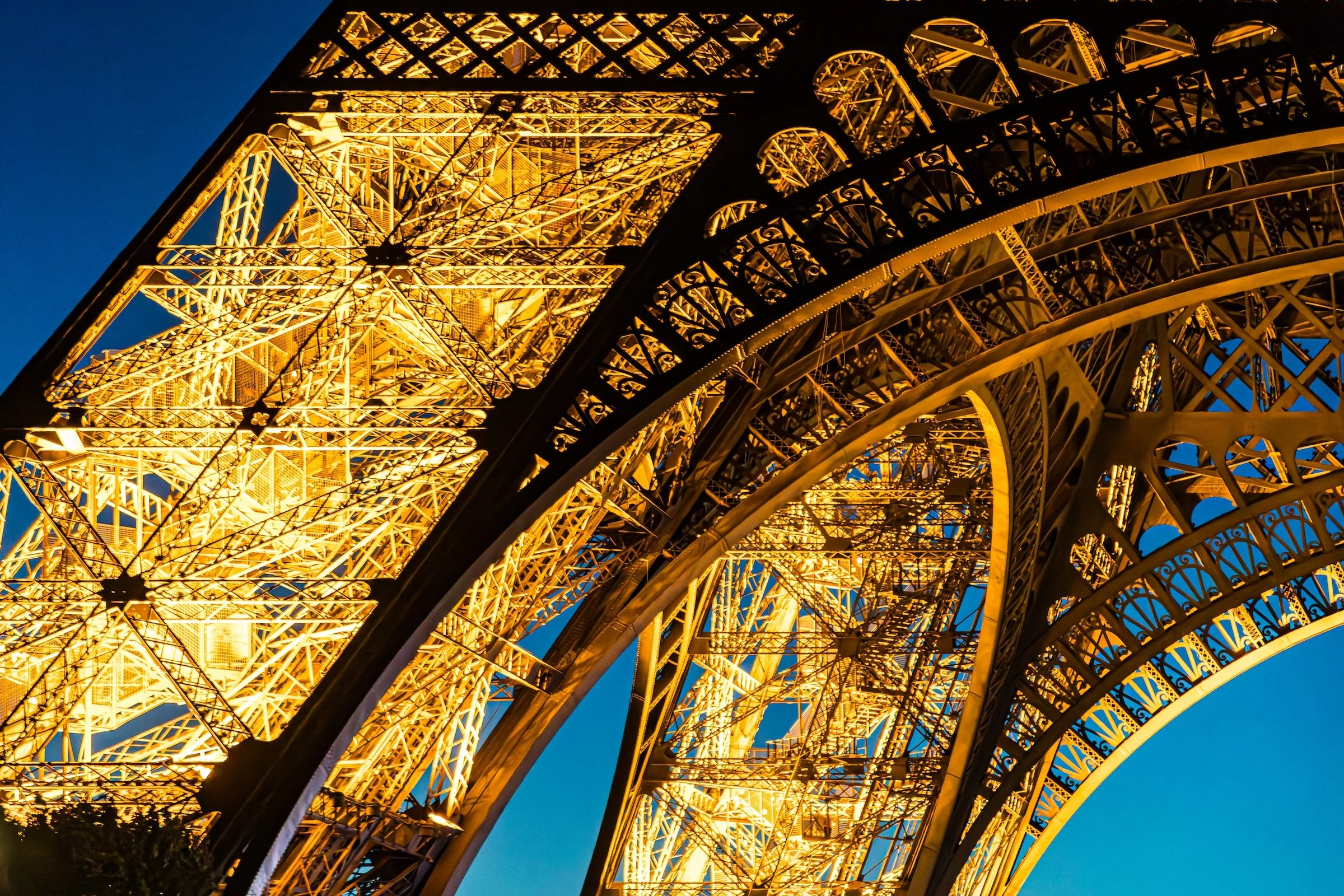
In the early and mid 20th century, Quinze-Vingts remained one of the key western quarters of the 12th arrondissement. The hospital continued its medical mission, the Gare de Lyon and rail corridors structured movement, and the streets around Bastille and Rue de Charenton carried a mixture of residents, workers, artisans, patients, travelers, and local commerce.
The quarter’s proximity to the Faubourg Saint-Antoine and the old craft districts meant that workshop memory remained important. Furniture trades, small manufacturing, repair, storage, and related businesses shaped the surrounding streets and courtyards. Quinze-Vingts belonged to a Paris where care and labor stood side by side.
During war, occupation, liberation, and postwar reconstruction, the quarter’s institutions and infrastructures took on additional weight. Hospitals, stations, and working streets are all essential in times of crisis. Quinze-Vingts was not a symbolic battlefield in the simple sense, but it belonged to the city’s infrastructure of survival: treatment, movement, labor, shelter, and return.
Early–Mid 20th Century
Late 20th Century
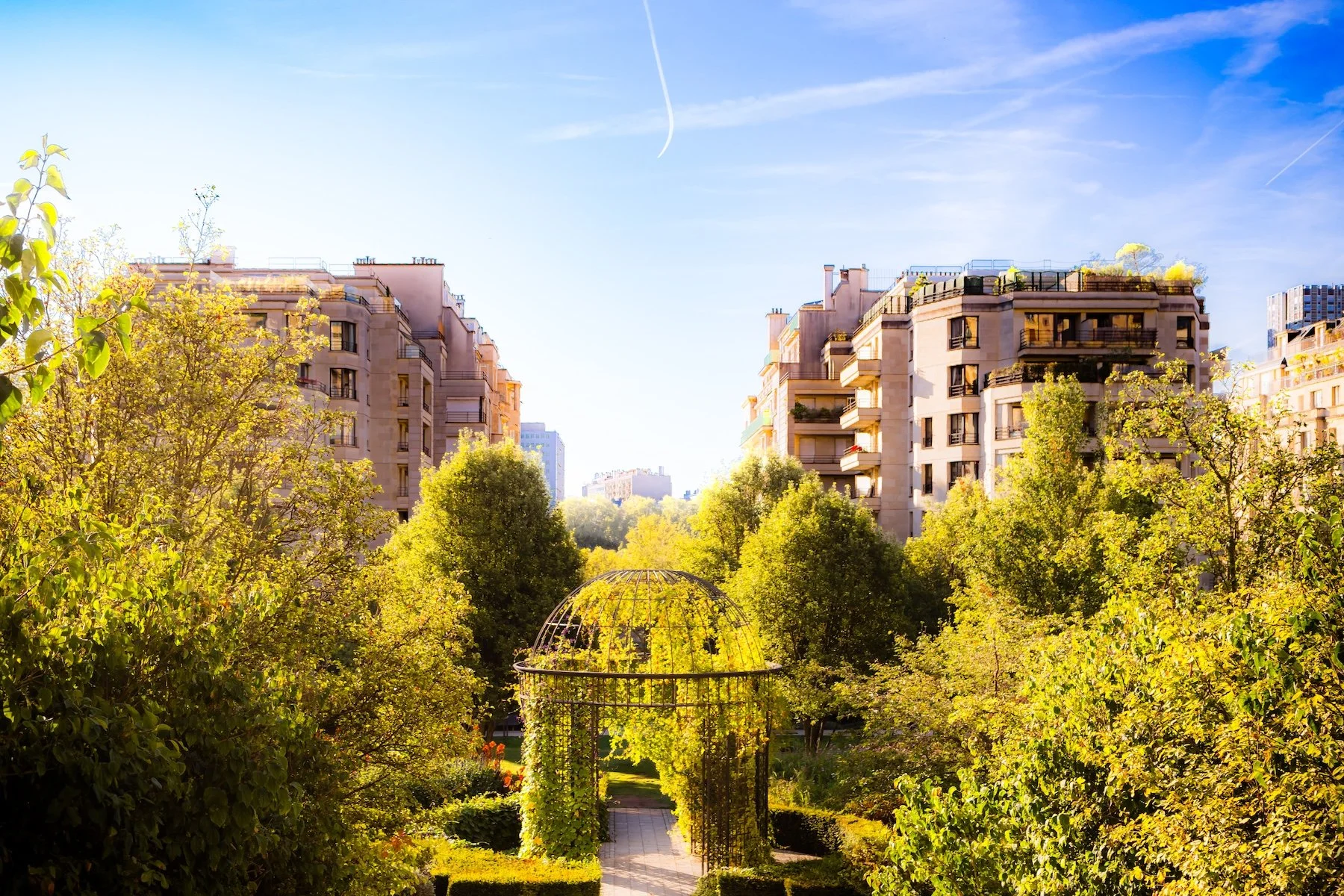
In the late 20th century, Quinze-Vingts became one of the most visible sites of urban reinvention in the 12th arrondissement. The old Bastille railway line lost its original function, and the viaduct and former rail corridor were reimagined as public and artisanal space. The transformation of the former rail line into the Coulée verte René-Dumont and the occupation of the arches by artisans turned infrastructure into one of the great urban reuse projects of Paris.
The creation of the Opéra Bastille in 1989 also changed the western edge of the quarter. Bastille became a major contemporary cultural node, and the streets immediately east of the square absorbed new flows of audiences, workers, visitors, deliveries, and cultural infrastructure. Quinze-Vingts became linked not only to hospital and rail memory, but to late-20th-century cultural planning.
This period brought both continuity and change. The hospital remained a serious institutional anchor. The former rail viaduct became a design and craft corridor. The elevated line became a planted promenade. The western 12th shifted from industrial and infrastructural logic toward culture, leisure, artisan identity, and urban heritage.
In the 21st century, Quinze-Vingts is one of the 12th arrondissement’s most layered and walkable quarters. It connects Bastille, Opéra Bastille, Gare de Lyon, Rue de Charenton, Avenue Daumesnil, the Viaduc des Arts, and the beginning of the Coulée verte René-Dumont. It is both historic and contemporary, institutional and recreational, practical and increasingly polished.
The Hôpital national des Quinze-Vingts remains a major ophthalmology institution, located at 28 Rue de Charenton and carrying more than 700 years of institutional history. Its presence gives the quarter continuity at a depth that most contemporary visitors may not immediately recognize. People may come for Bastille, the Viaduc des Arts, the Coulée verte, or Gare de Lyon, but the administrative name directs attention back to care, sight, and the medieval foundation beneath the modern street.
For CityNeighborhoods: Paris, Quinze-Vingts is essential because it shows how an administrative quarter can hold several kinds of transformation at once. It is not merely the Bastille edge, not merely a hospital district, not merely a station landscape, and not merely an adaptive-reuse showcase. It is a quarter where Paris repeatedly converts inherited structures into new forms of use — and where the old mission of care remains central to the name.
21st Century
Spirit and Legacy
Quinze-Vingts is the quarter where Paris turns care, movement, and reuse into neighborhood identity. Its spirit is practical, humane, and adaptive. It belongs to blind residents and ophthalmology patients, barracks and hospital courtyards, railway arches and artisan workshops, planted promenades and station crowds, Bastille’s edge and the beginning of the eastern 12th.
Its legacy is the transformation of service across centuries. A medieval foundation for blind Parisians became a national ophthalmology hospital. A military barracks became a care institution. A rail viaduct became a craft corridor. A railway line became a garden in the sky. Each layer tells the same story in a different language: Paris survives by reusing what it has built, while carrying memory forward into new forms.
To walk Quinze-Vingts is to encounter Paris as continuity through conversion. The quarter does not preserve the past by freezing it. It preserves the past by giving it new work to do. In Quinze-Vingts, neighborhood identity is not only seen; it is cared for, crossed, repaired, planted, and remade.
The Photography
The arrondissements do not share a single visual identity. Instead, they organize Paris into twenty broad visual fields, each gathering its own combination of landmarks, streetscapes, institutions, residential districts, commercial corridors, parks, rail stations, markets, cemeteries, and riverfront edges.
Some arrondissements are defined by monumental scale: royal palaces, ceremonial avenues, government buildings, museums, formal gardens, and internationally recognized landmarks. Others are shaped by hills, canals, rail gateways, apartment-lined boulevards, neighborhood markets, former village streets, industrial remnants, parks, or the quieter rhythms of residential Paris. The arrondissement system gives these varied landscapes a civic frame, allowing the city to be read not as one visual language, but as a sequence of overlapping Parisian atmospheres.
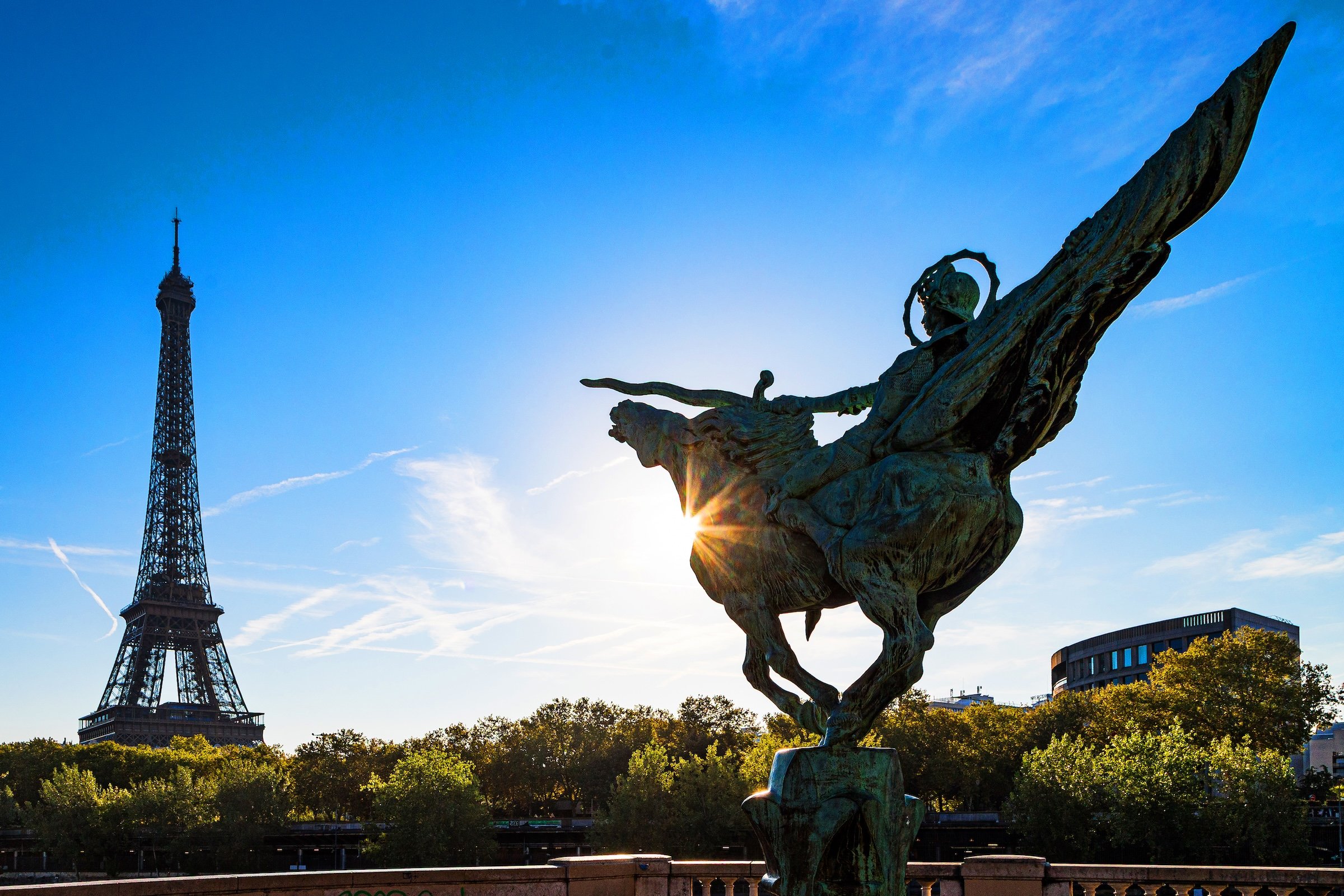
Visual Identity
Through The Lens
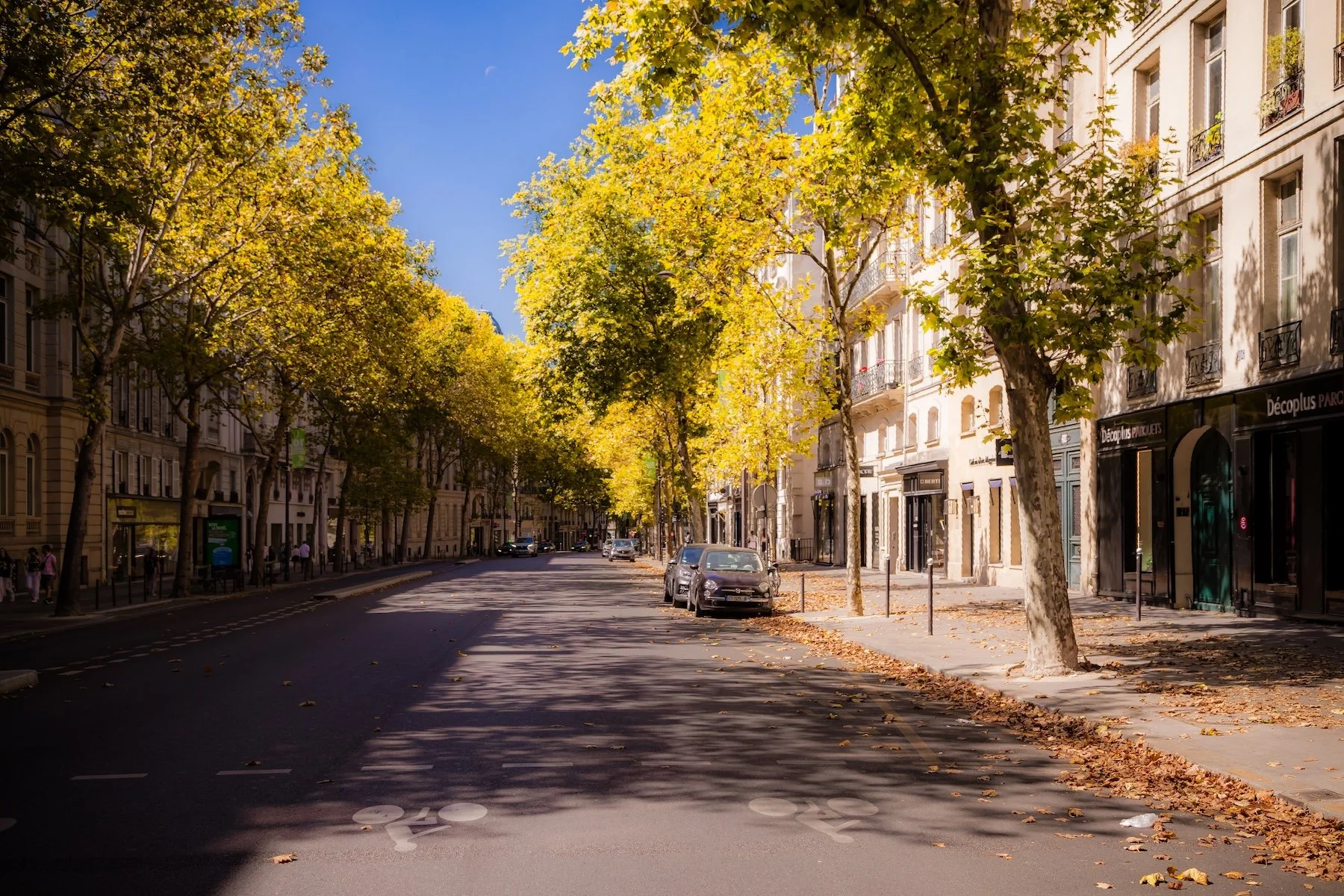
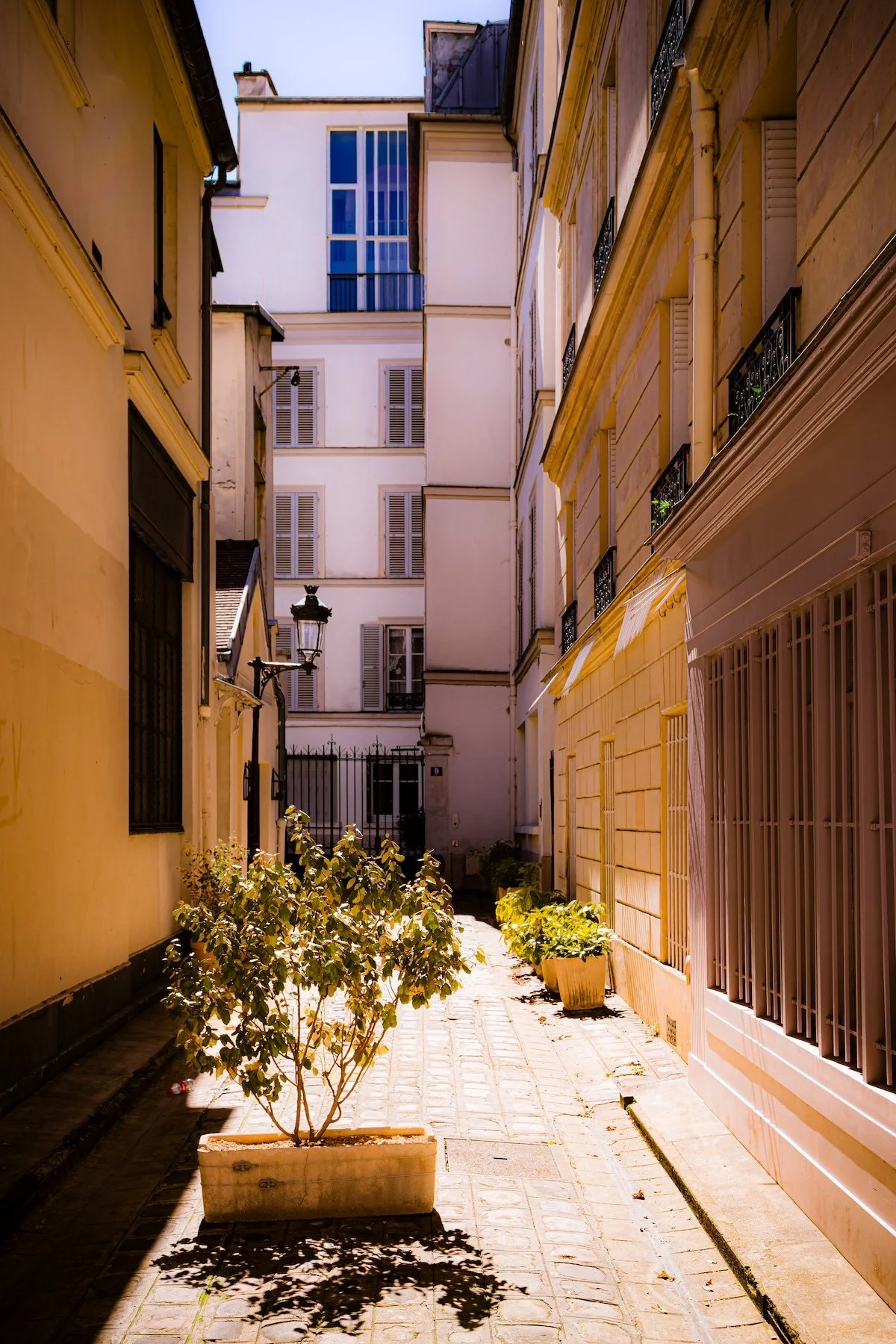
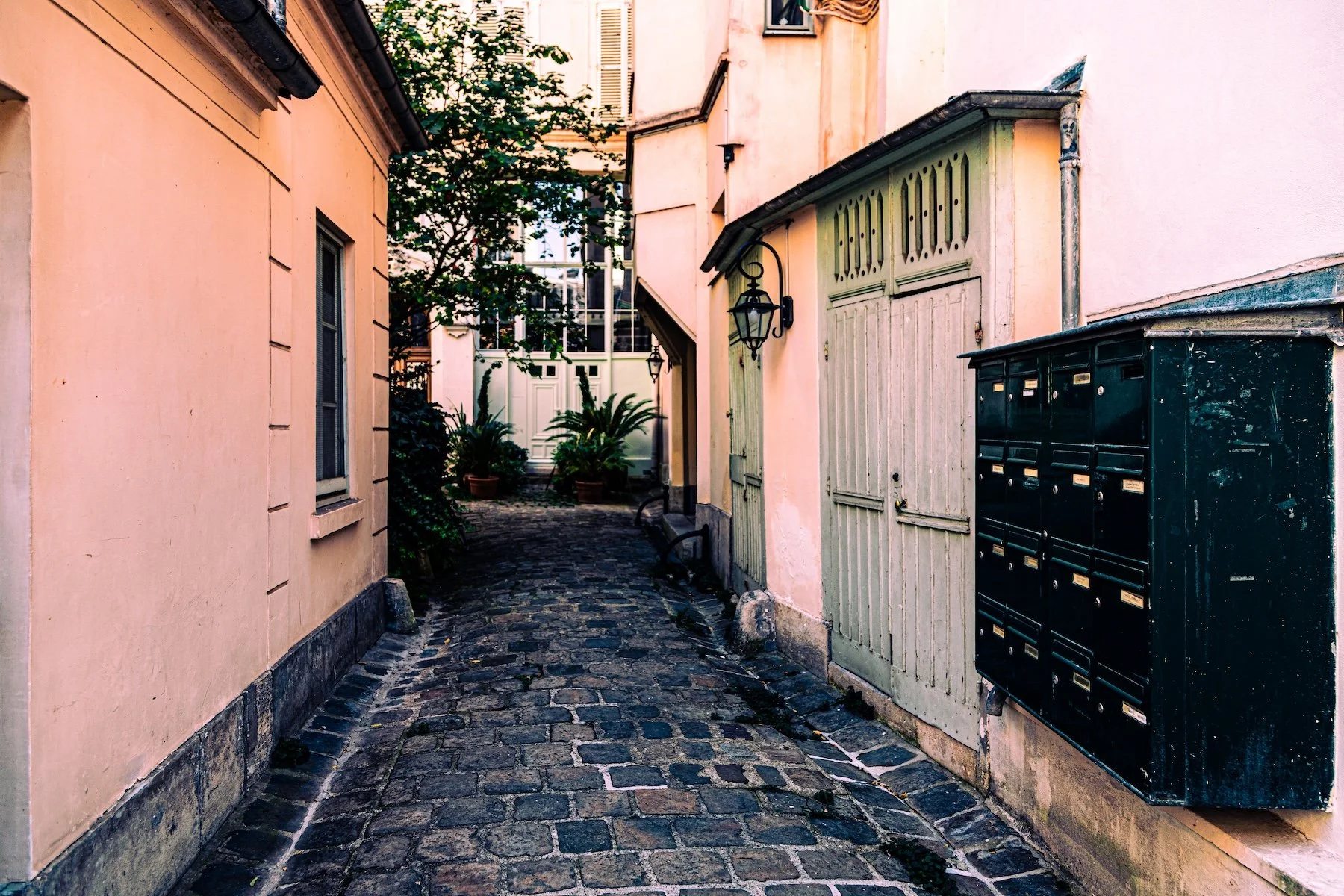
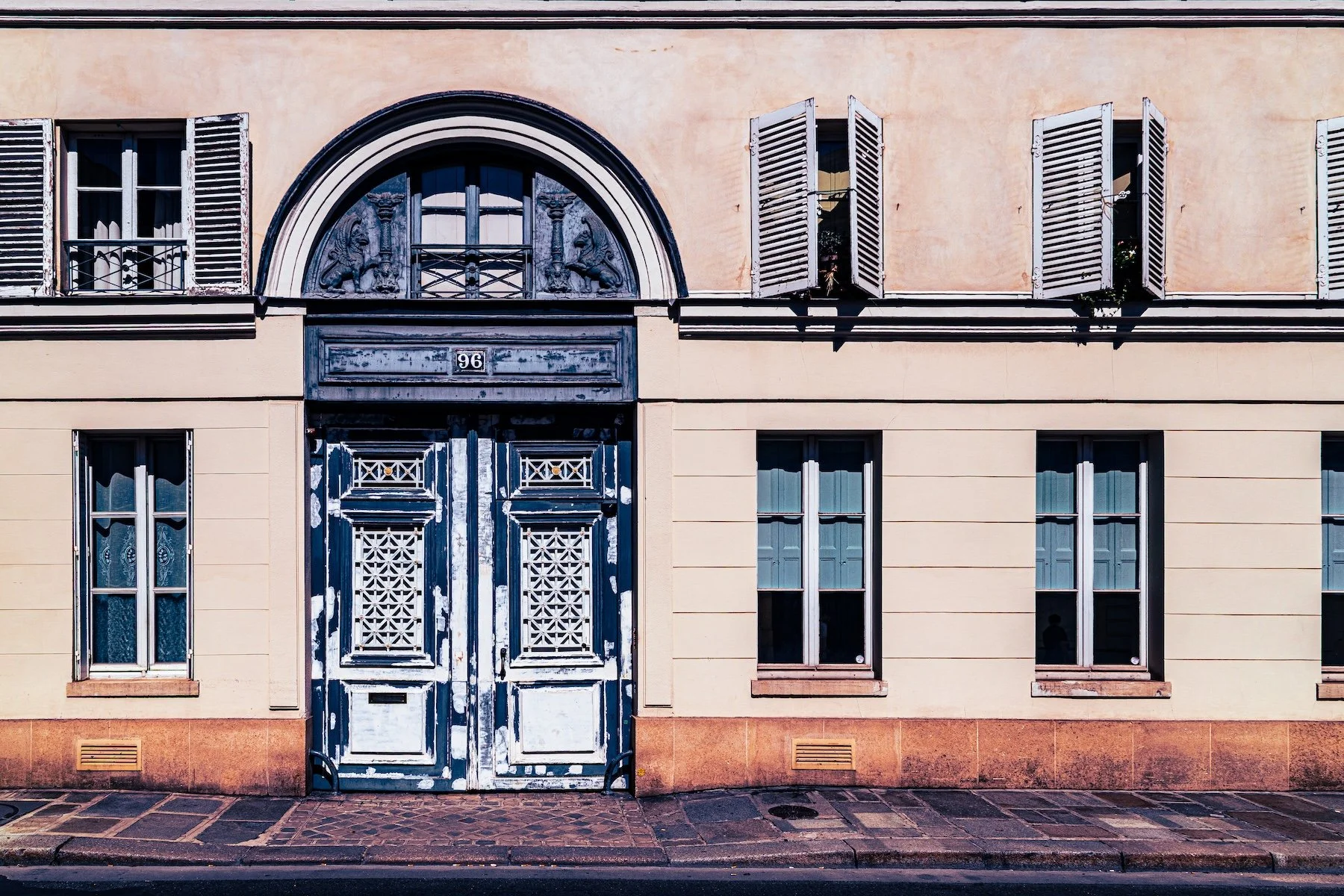
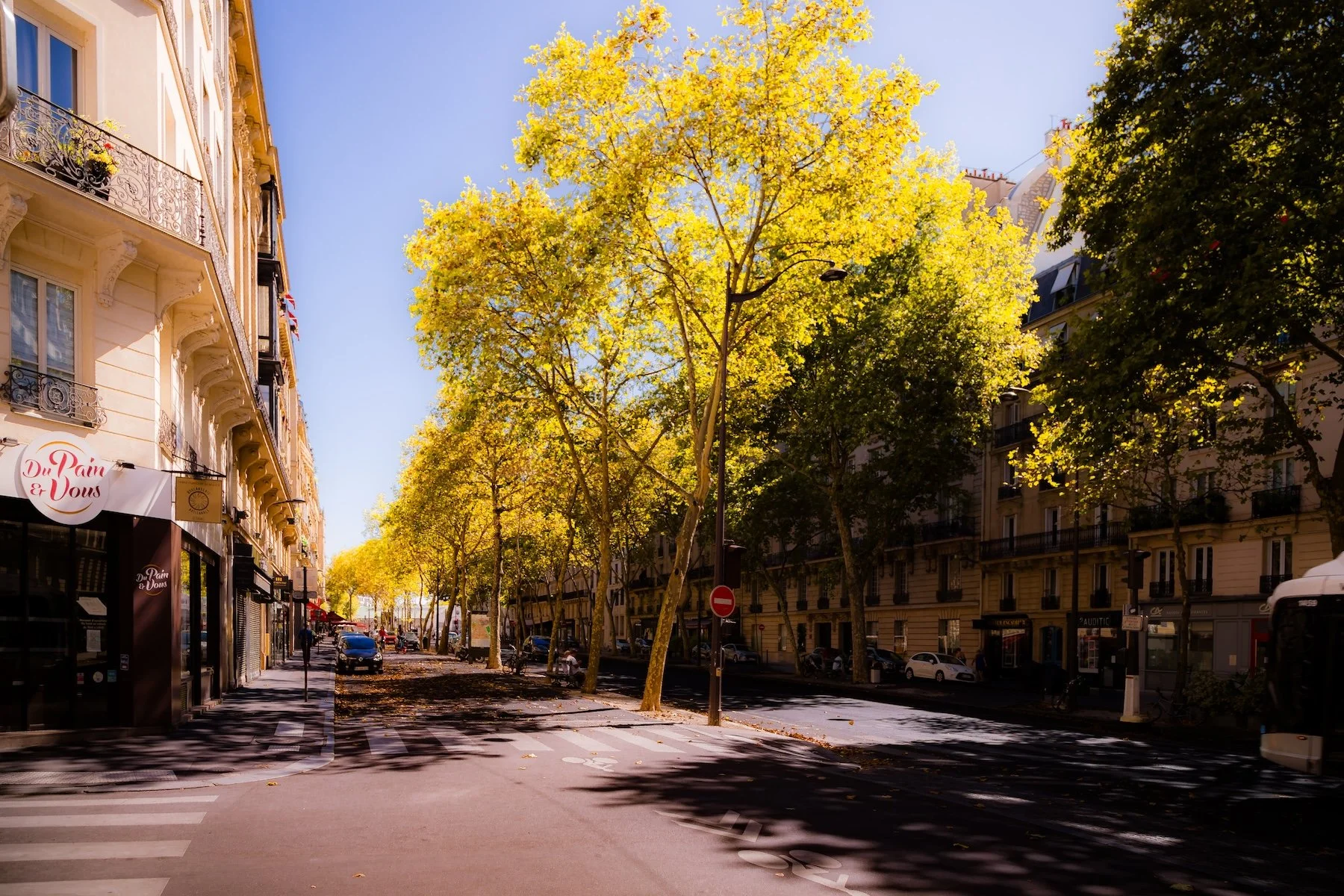
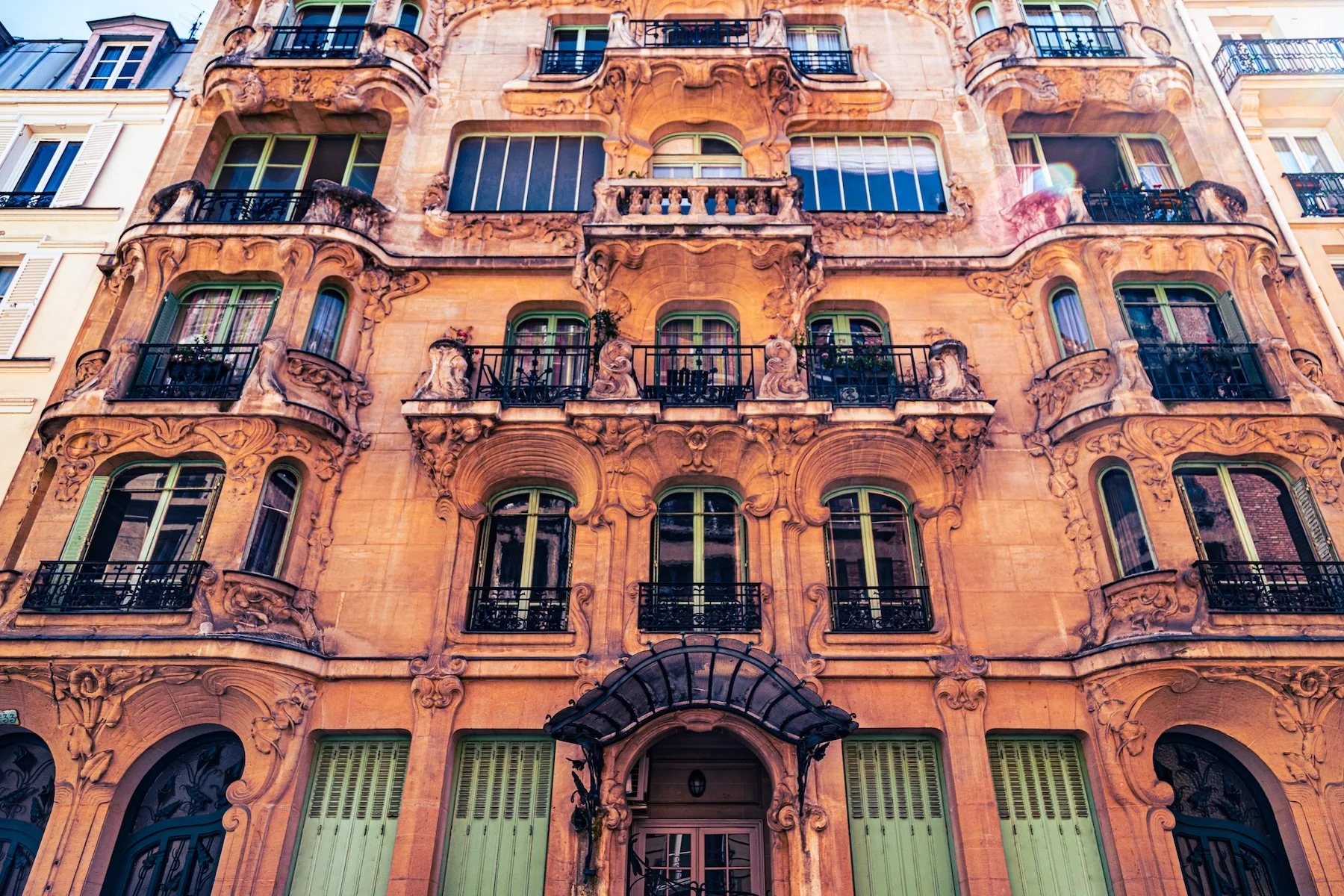
Photographing the arrondissements means moving between the official map and the street-level experience. The camera does not treat each arrondissement as visually uniform. Instead, it looks for the recurring forms, textures, transitions, and contrasts that make each district legible: the geometry of boulevards, the shade of plane trees, the repetition of balconies, the rise of stairways, the curve of canals, the presence of rail stations, the opening of parks, the weight of monuments, and the intimacy of side streets.
On CityNeighborhoods, the arrondissement provides the frame, but the photograph comes from the encounter between map, movement, light, and observation. As the Paris photography is processed, this section will connect each arrondissement more directly to the project’s Photographic Lexicon: the visual strategies, recurring motifs, and compositional patterns that shape how the city is seen through the lens.
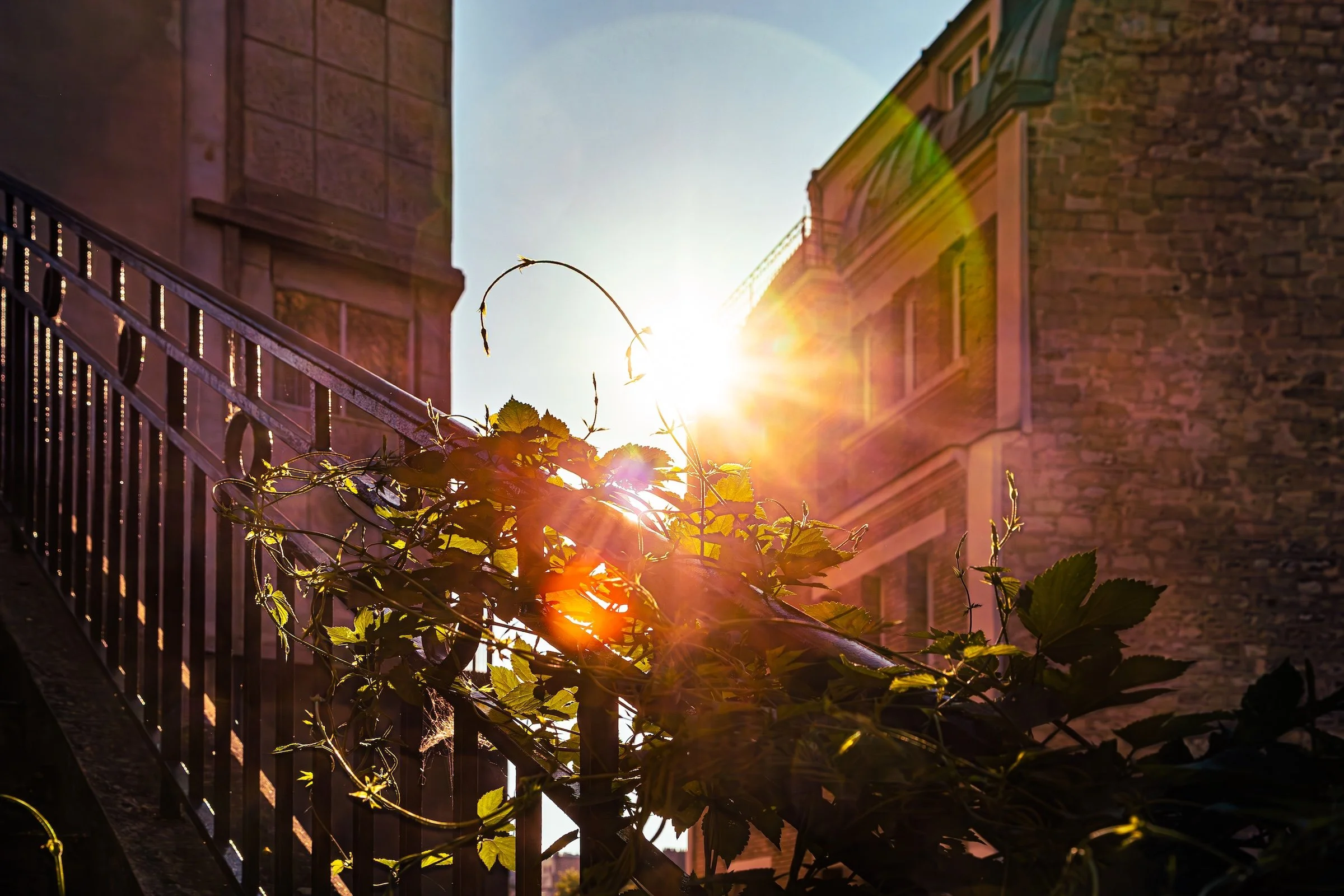
If you visit Paris, these ideas can help inspire your own photography.
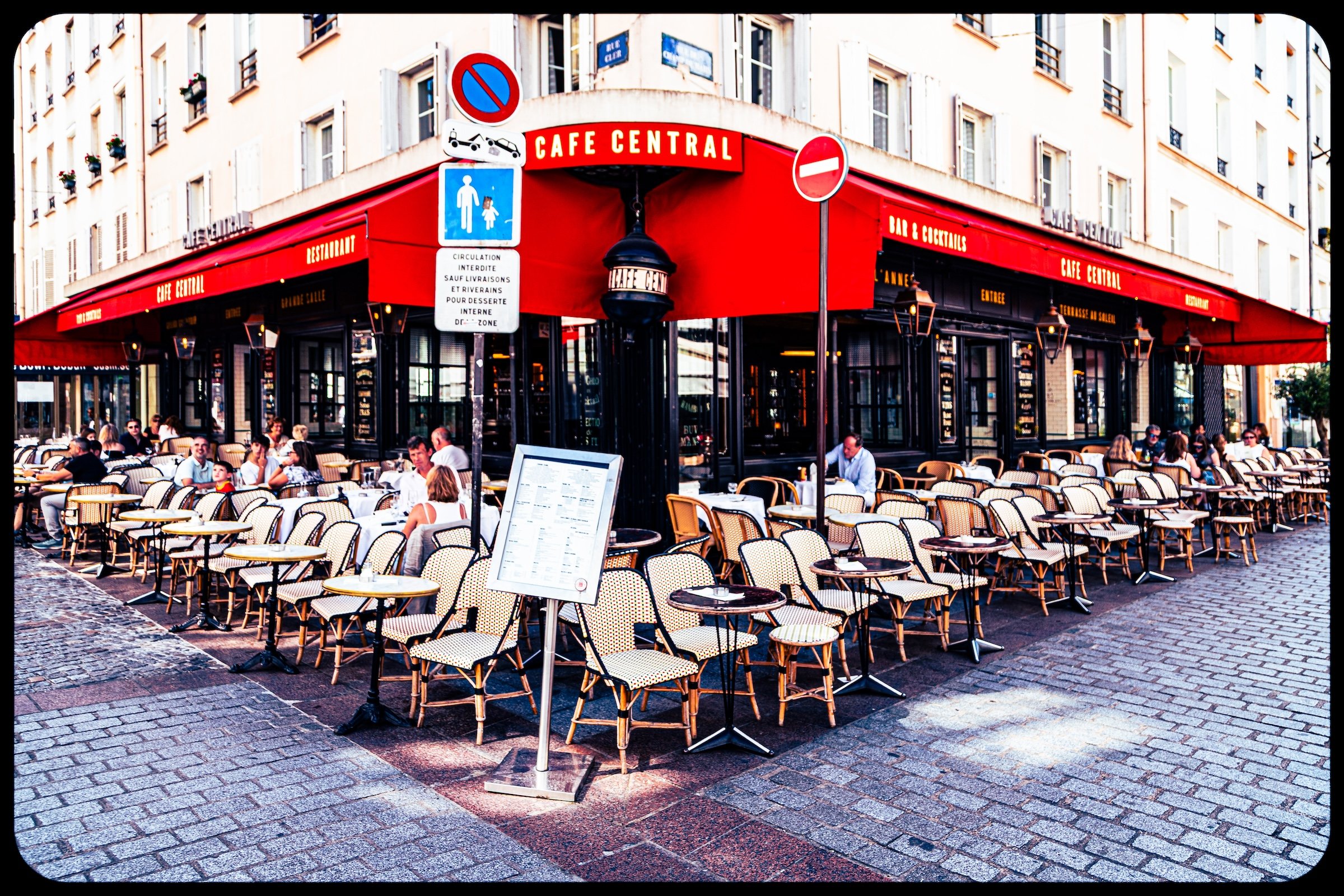
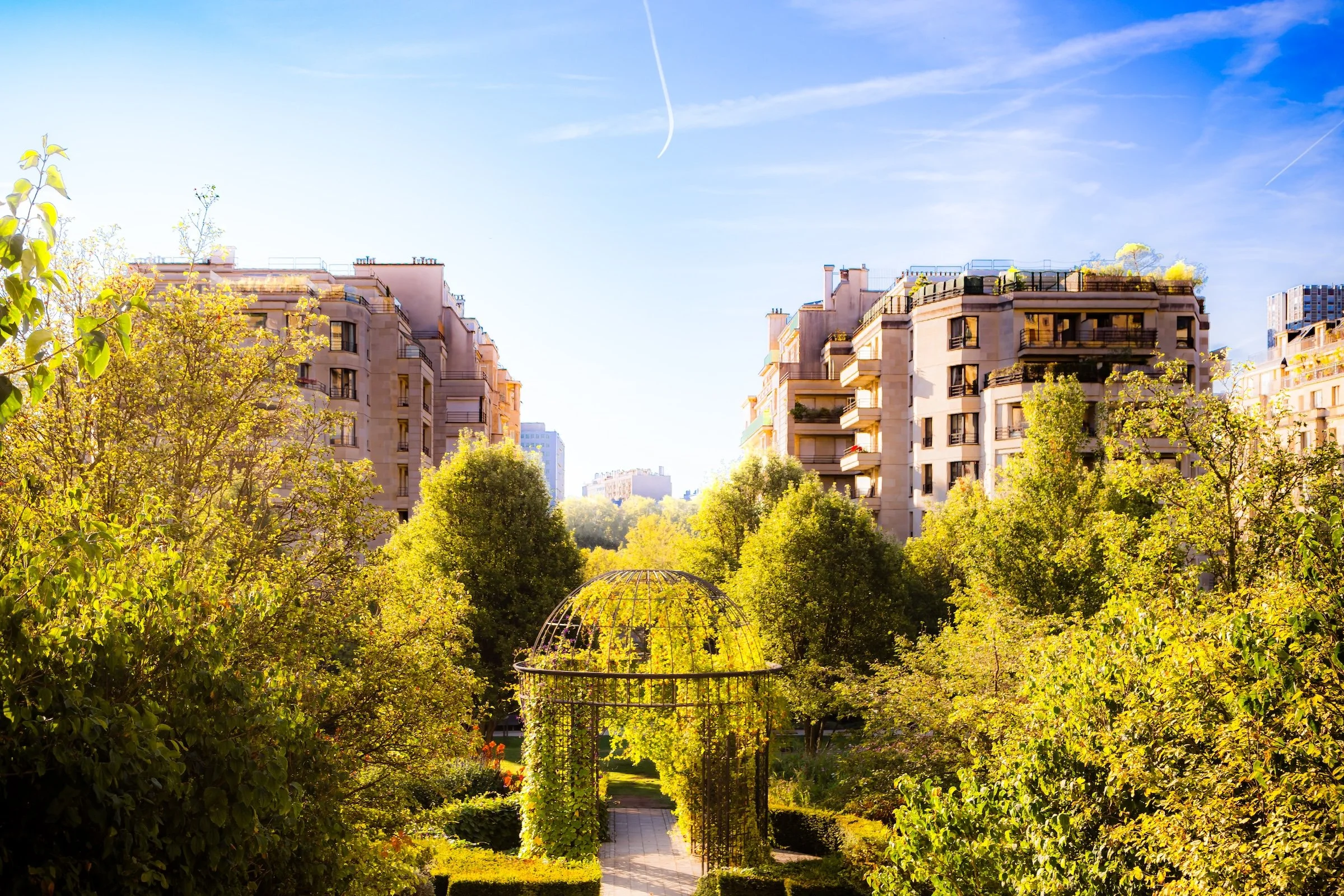
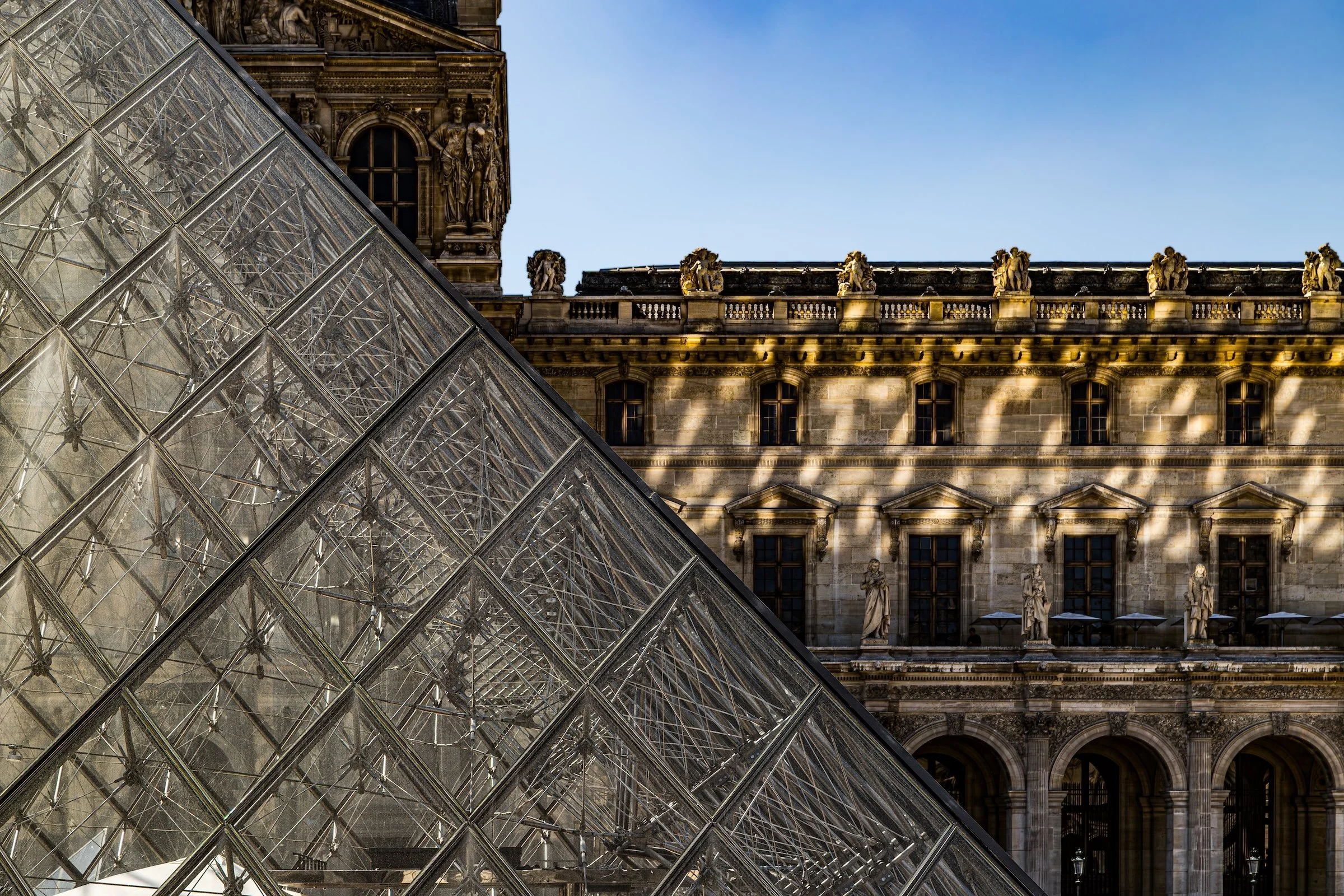
Paris: J’Espere, Je Rêve, Je Vive
Paris Photo Gallery
Paris Field Notes
-
Field Note: August 18, 2025 | 07:58 AM
Conditions: 73°F | Humidity: 72%.
Within the park's interior, the glacial kettle ponds acted as humidity traps, creating a soft, hazy light that filtered through the old-growth oaks. The transition from the park's dense shade to the sun-drenched edges of Oakland Gardens highlighted the day's exceptional "picture-perfect" clarity.
There is a fleeting window in Queens where the humidity of August hasn't yet heavy-set, and the morning sun hits the canopy of Alley Pond Park at a perfect oblique angle. Arriving just before 8:00 AM, I watched the light break through the oaks and tulip trees, casting long, dramatic shadows across the wet grass. It’s in these quiet, golden moments that the park feels less like a city escape and more like the ancient glacial valley it actually is.
Other neighborhoods visited:
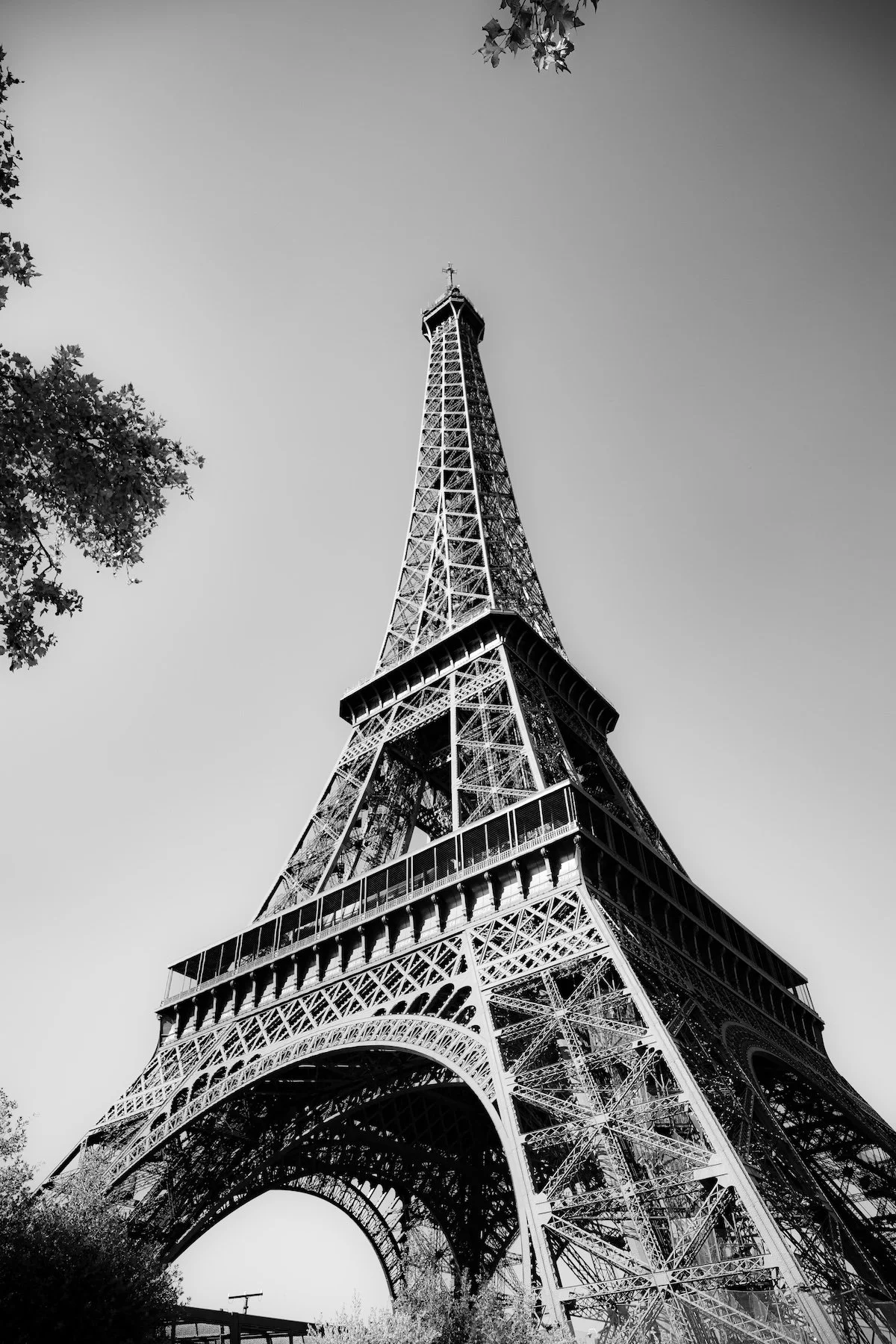
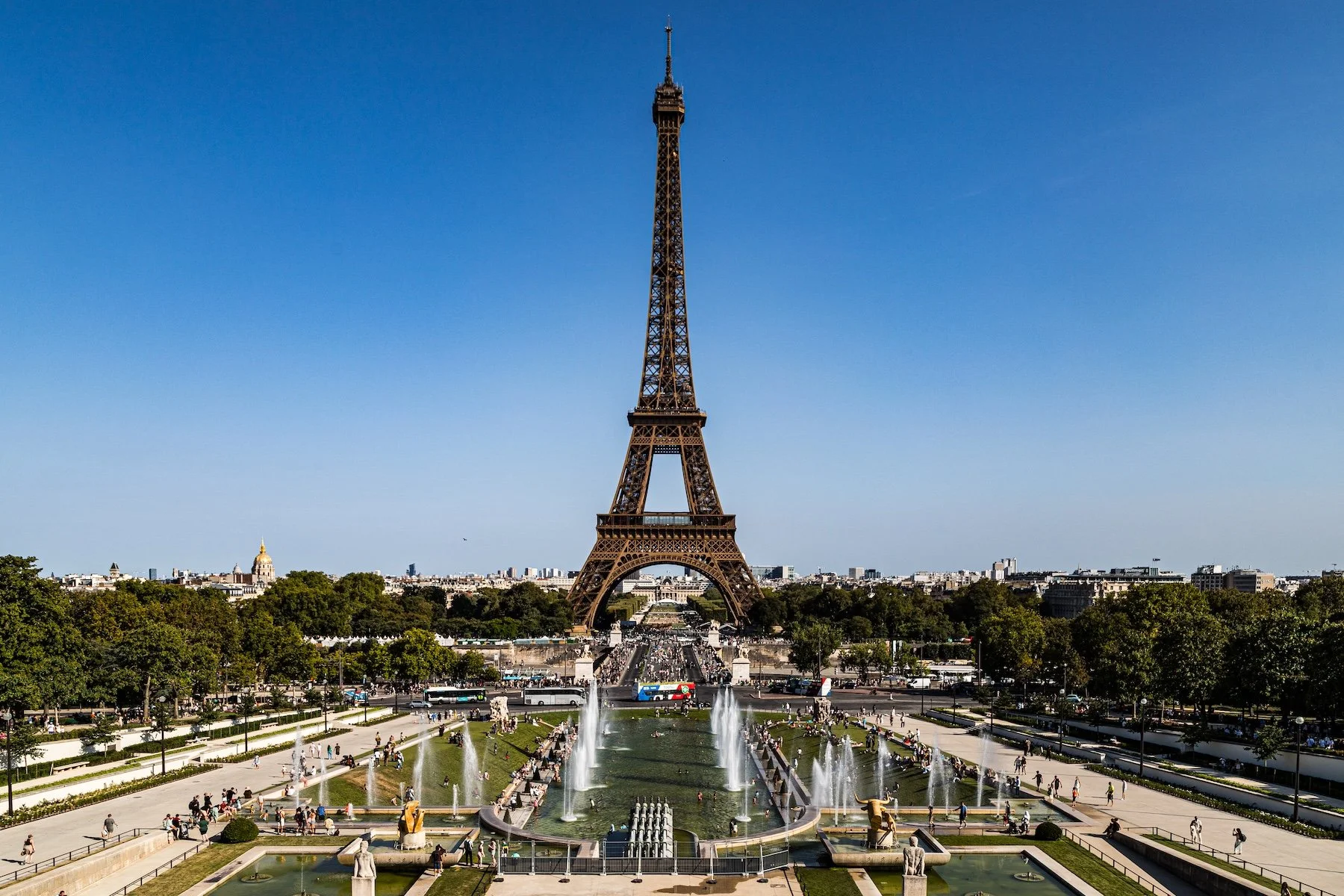
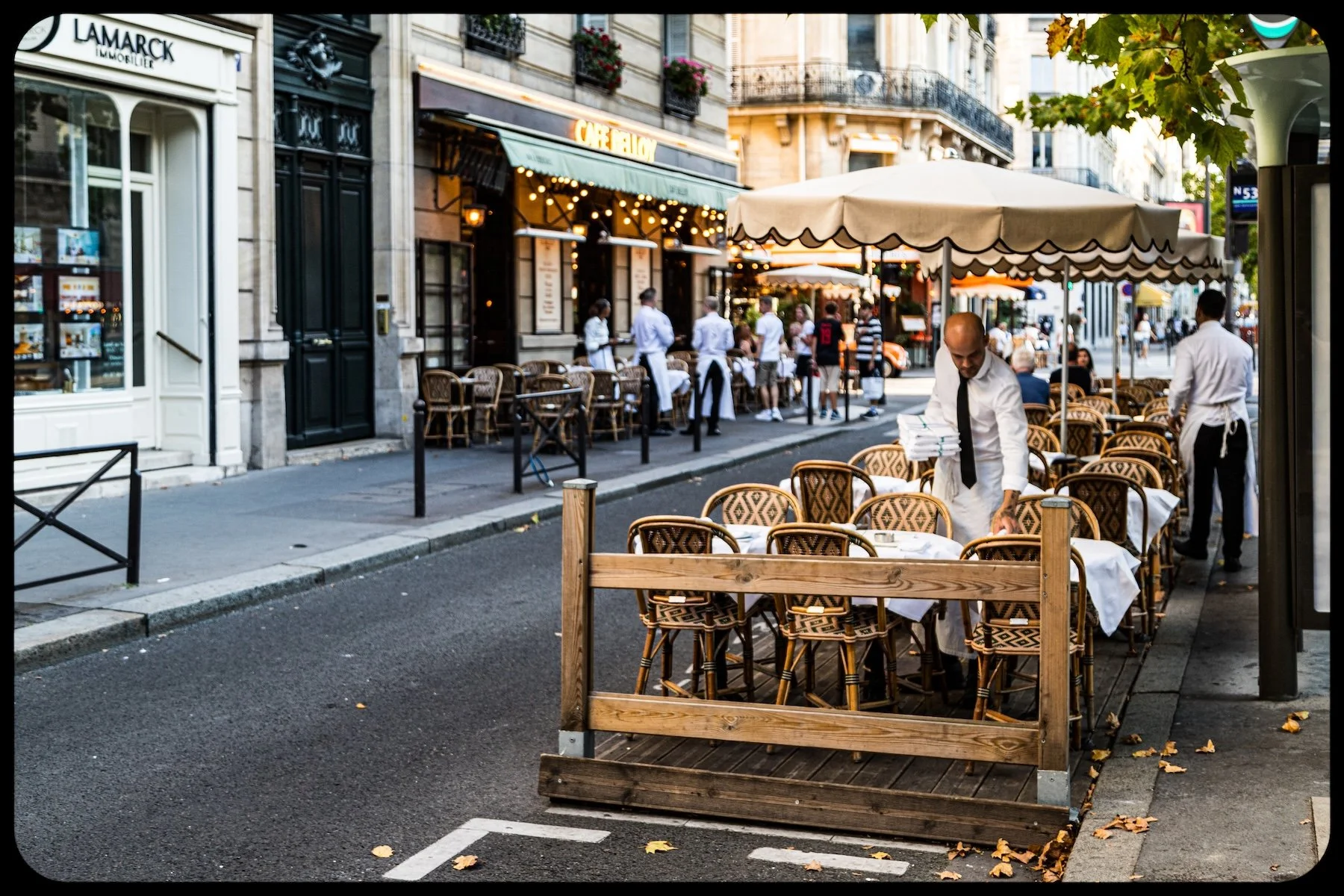
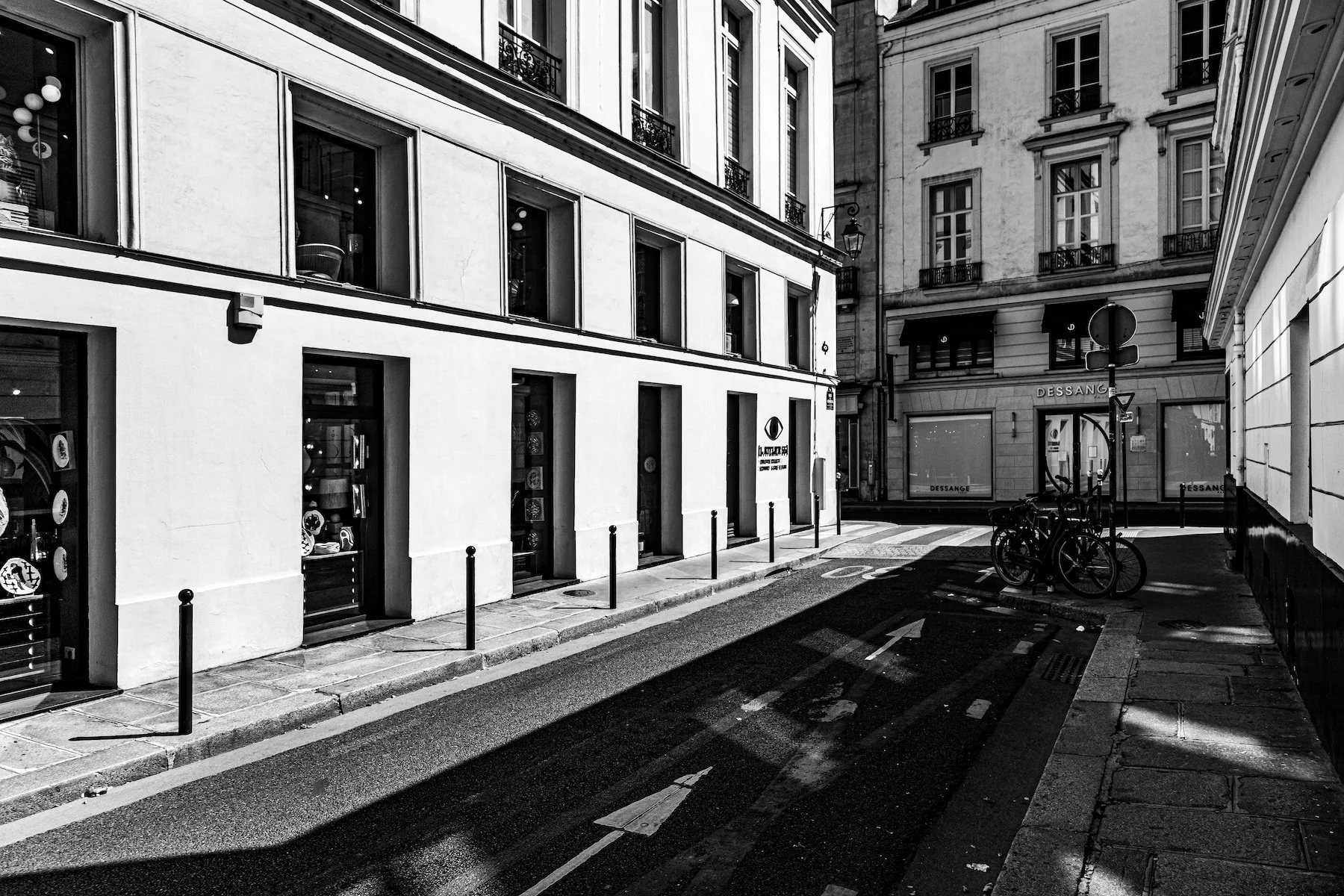
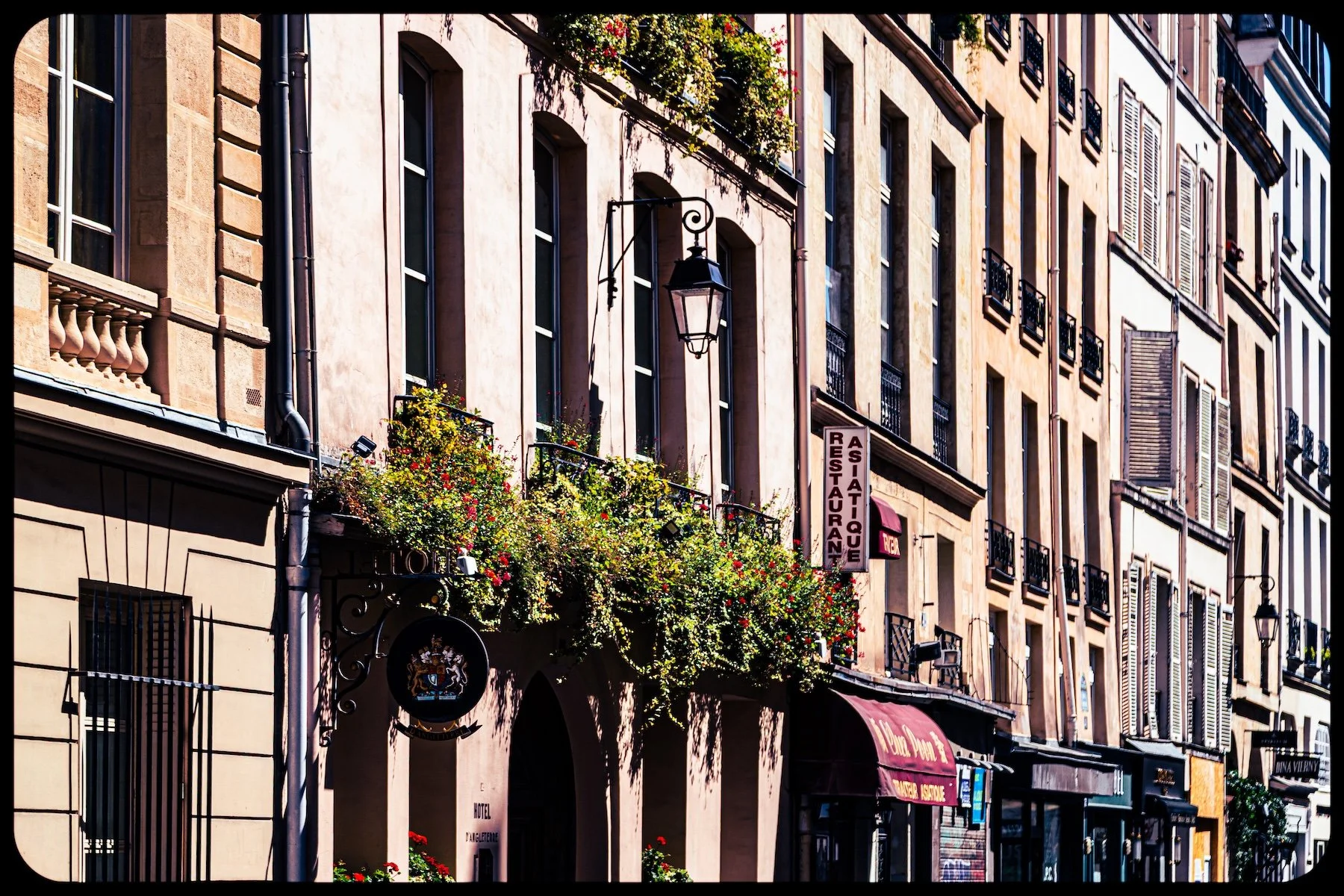
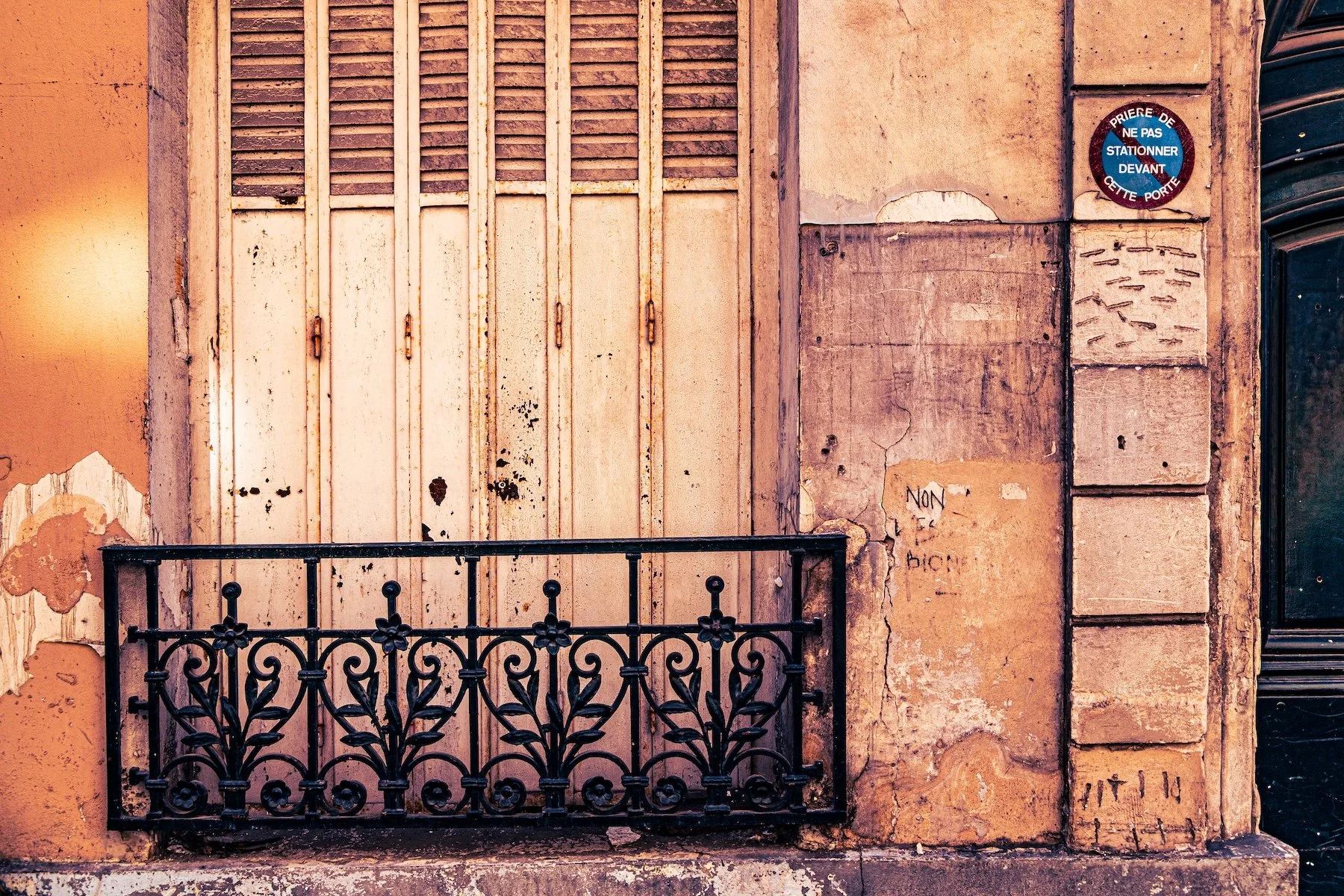
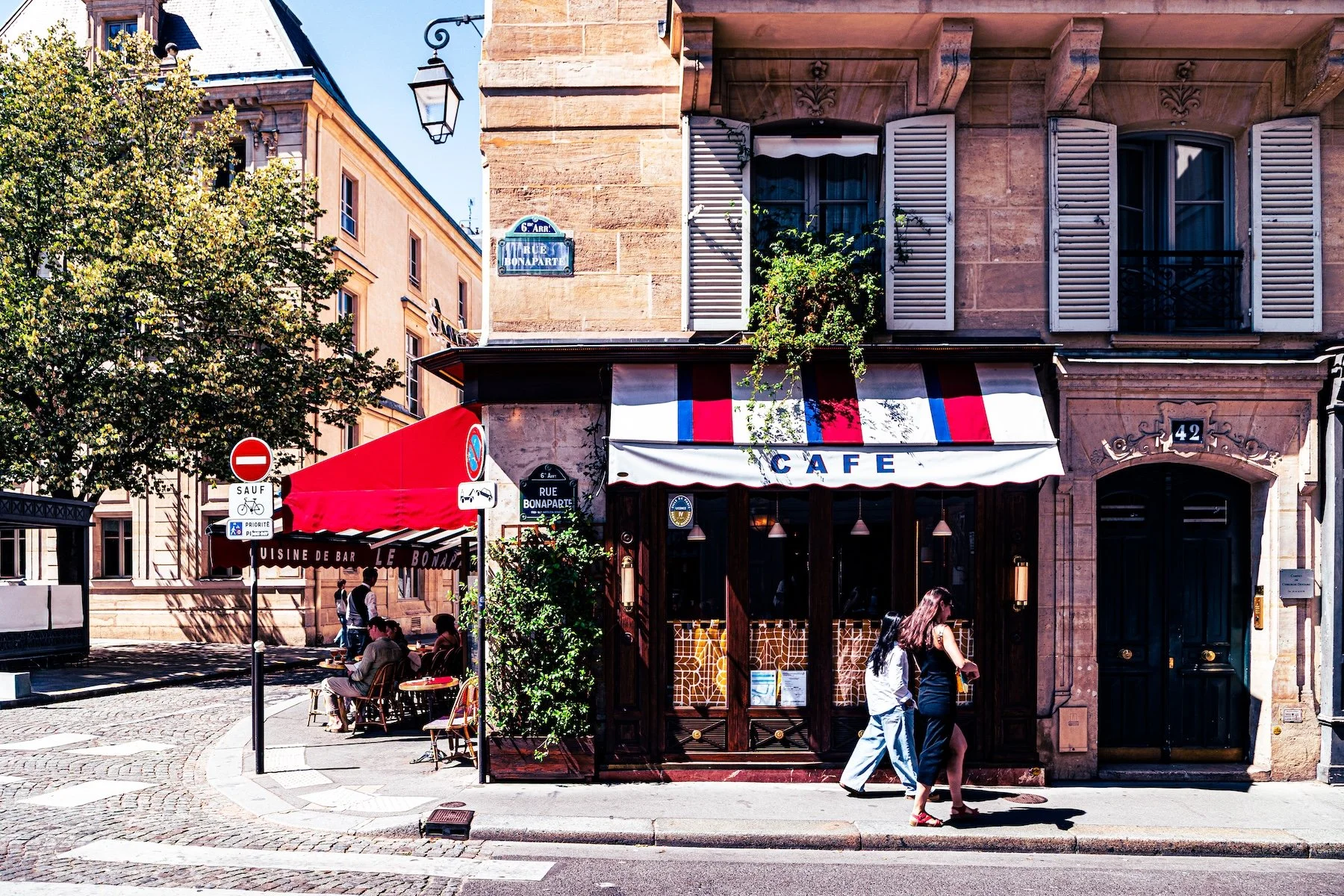
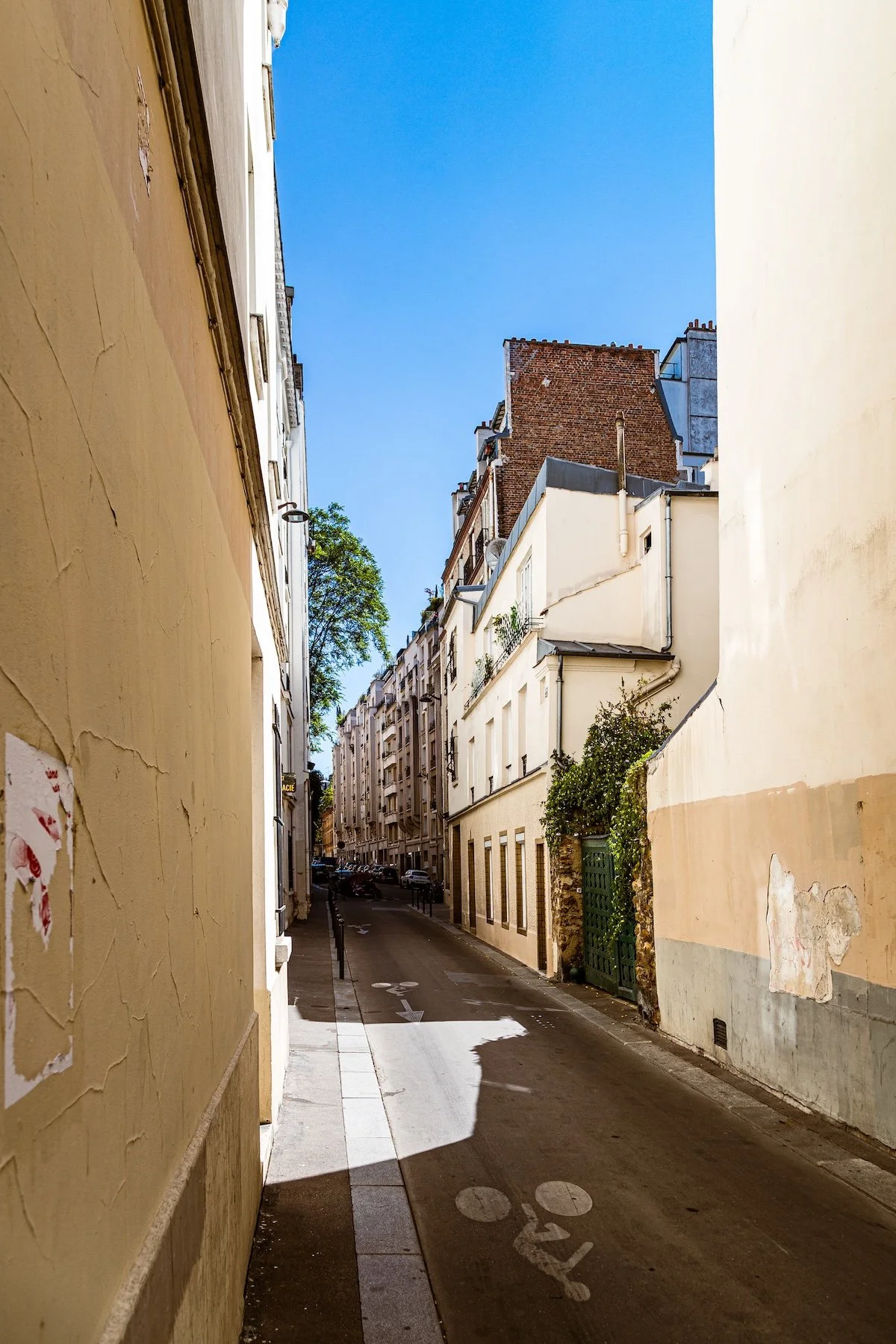
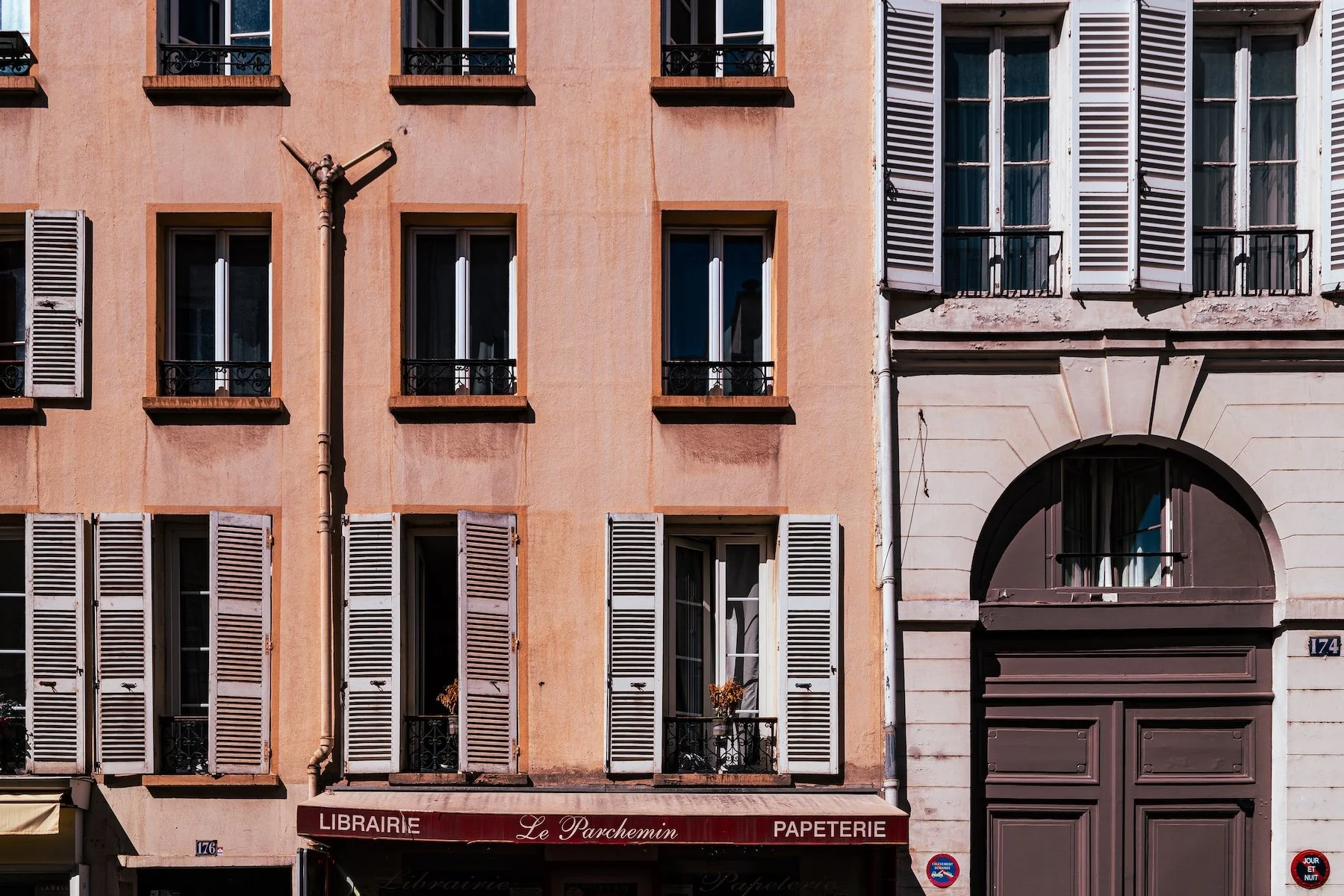
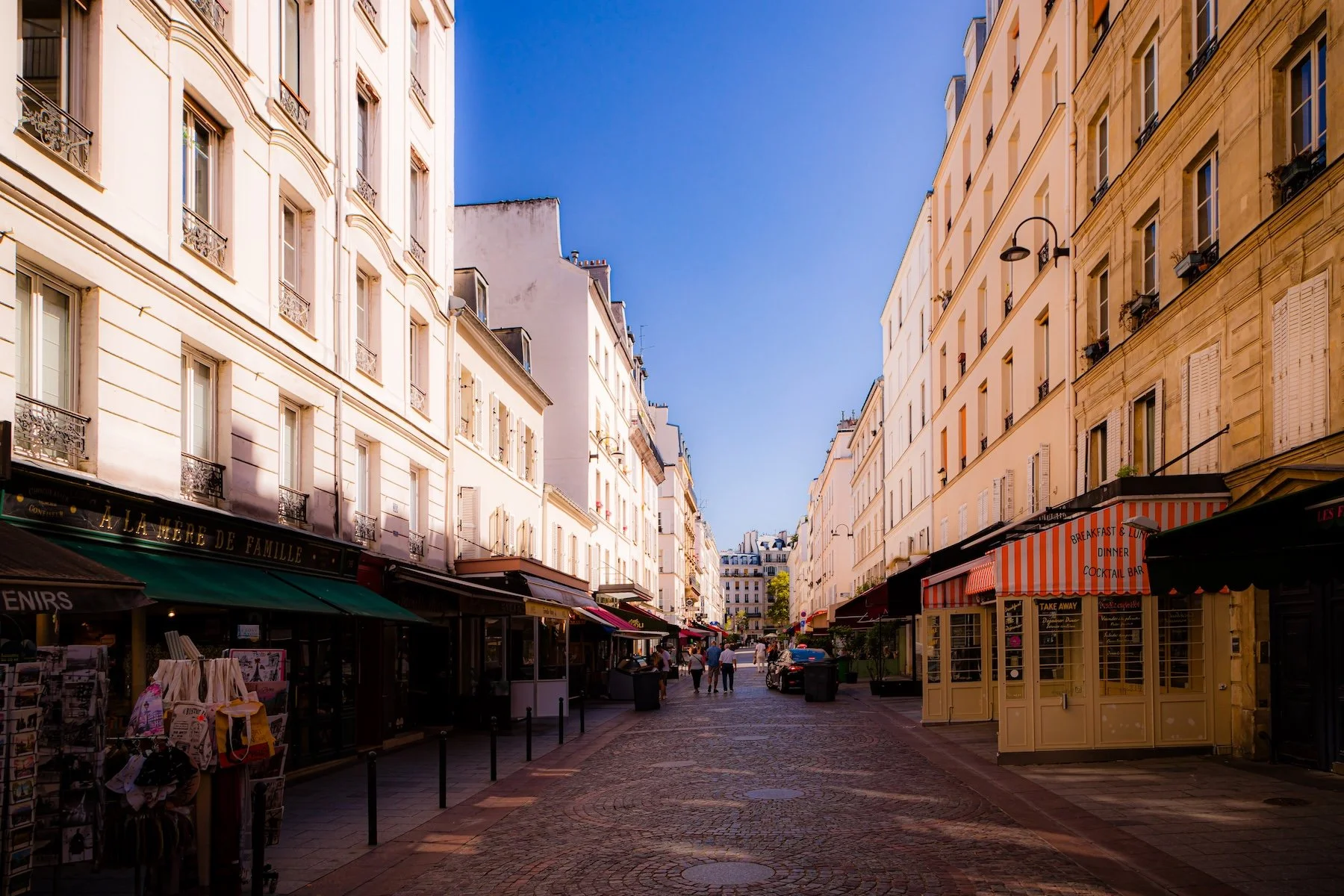
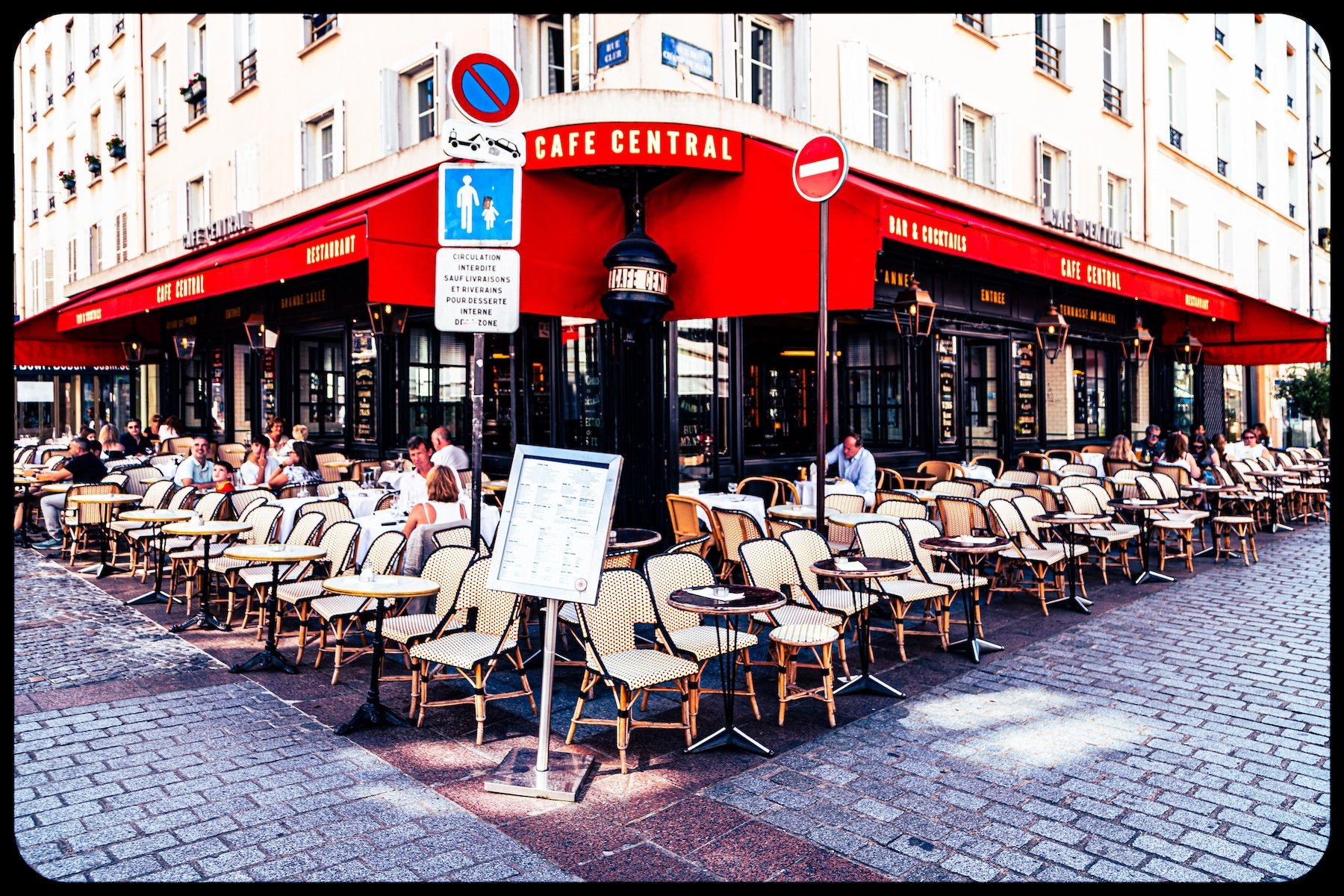
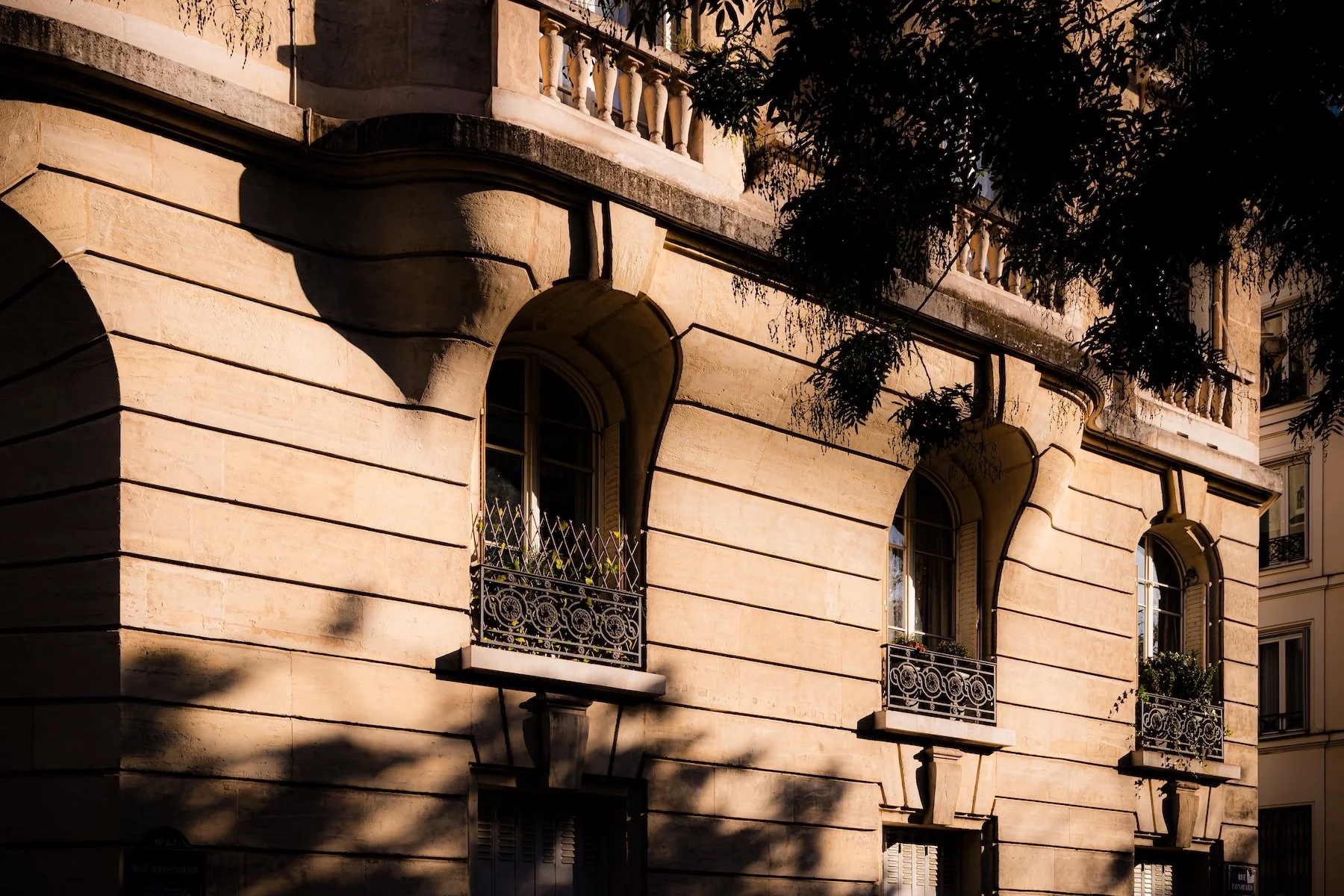
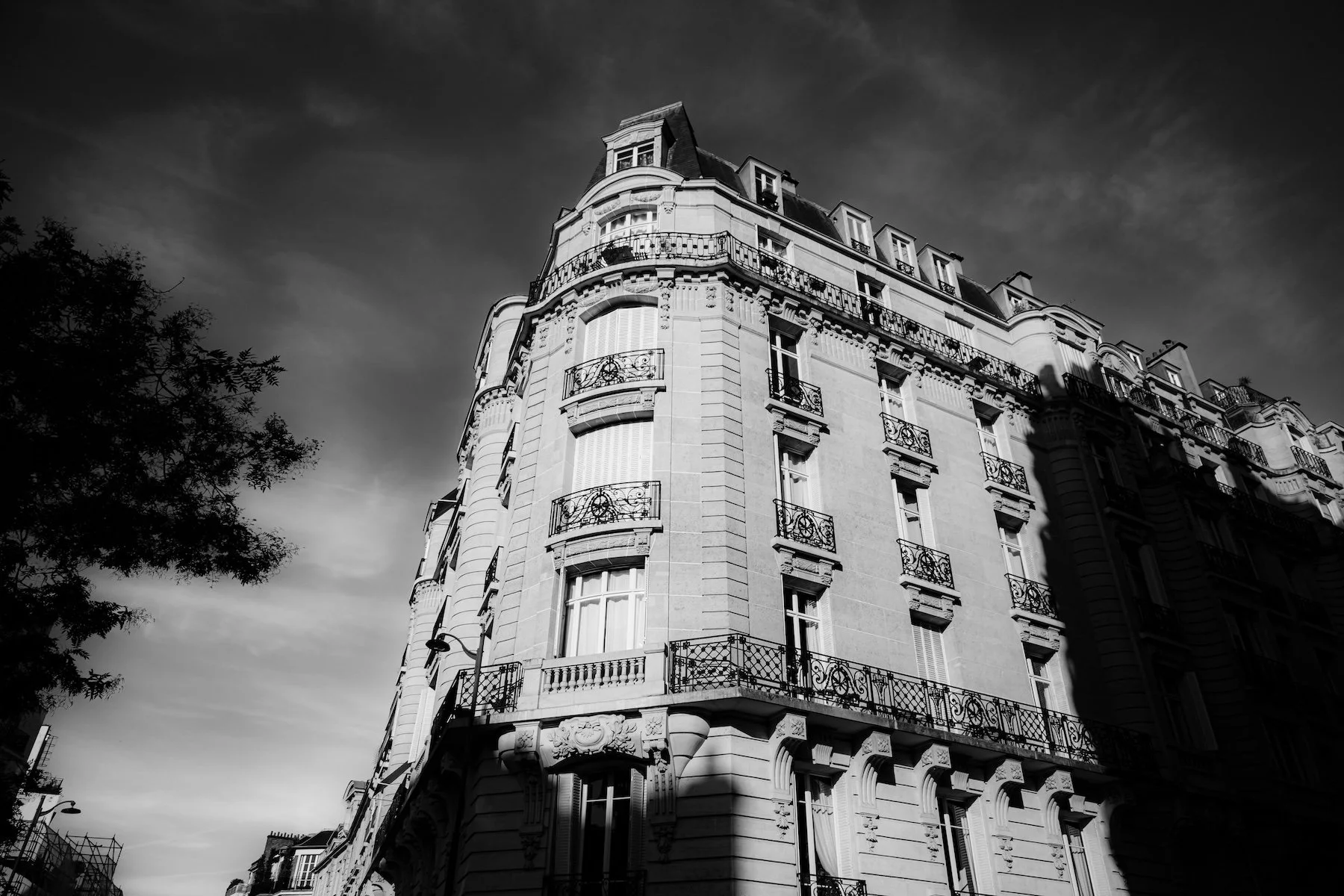
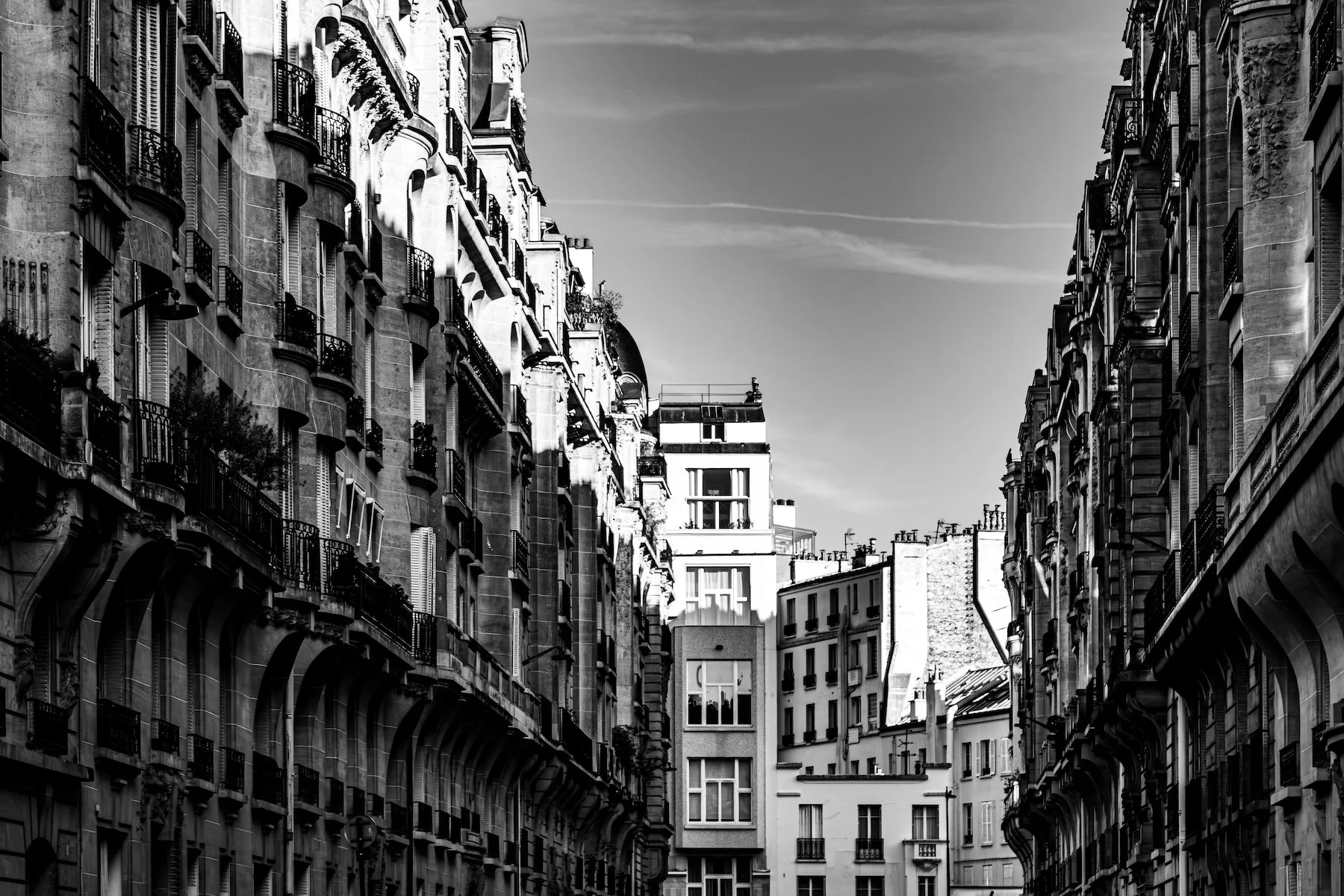
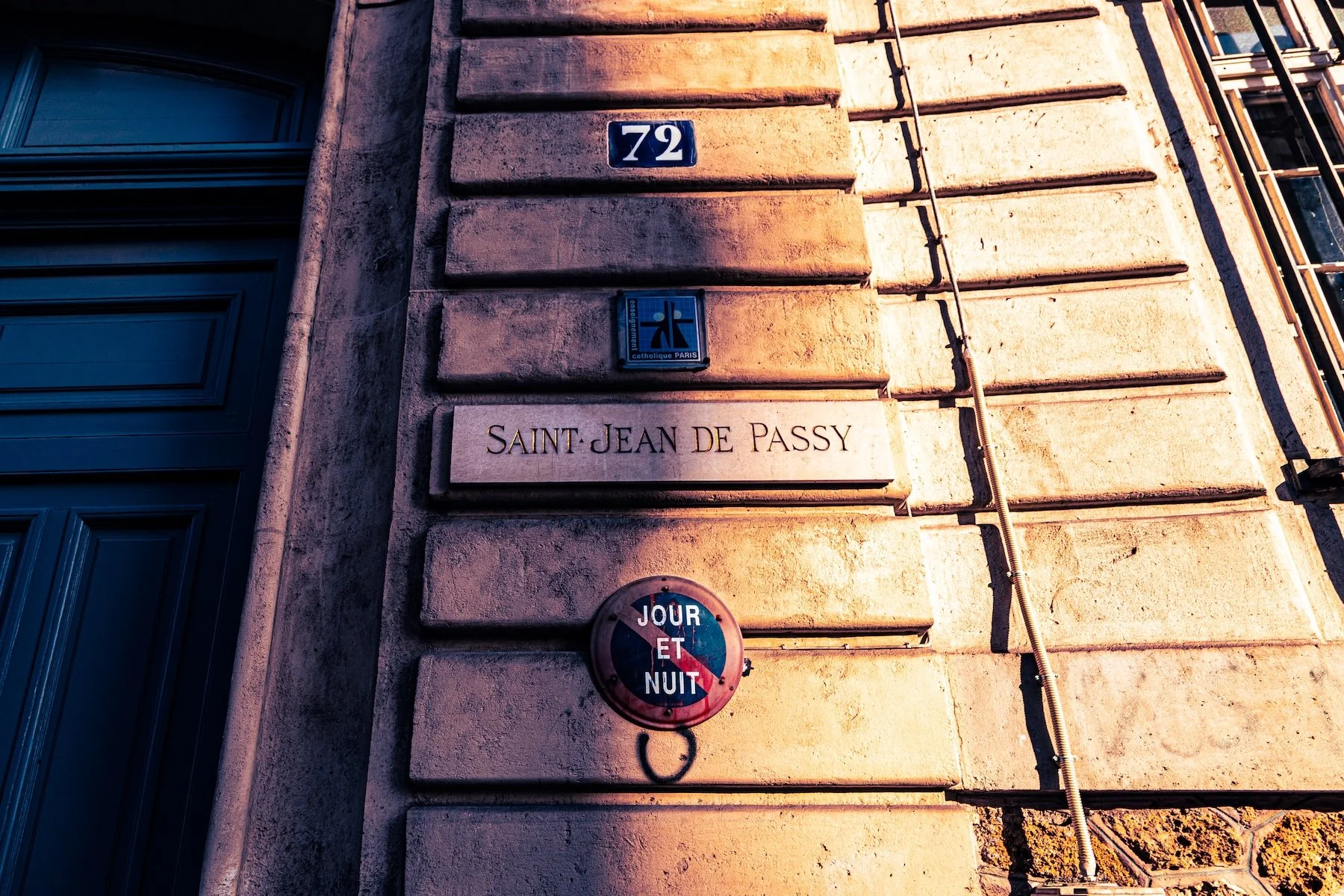

Explore Paris
-

The twenty arrondissements form the civic spiral of Paris, organizing the city into its broad local districts of government, identity, and daily life.
-

Each arrondissement is divided into four official administrative quarters, giving Paris a more precise civic and geographic framework.
-

The conseils de quartier bring participation to street level, giving residents a voice in neighborhood needs, public space, and local civic life.
-

Les Deux Rives trace Paris through the Seine’s two banks, revealing how the Rive Droite and Rive Gauche shaped the city’s civic power, commerce, learning, art, and cultural identity.
-

Cultural neighborhoods reveal the Paris people recognize through history, cafés, architecture, memory, atmosphere, and local belonging.